

Finding a business web site might seem easy until you have to look for businesses that share a similar name, or operate under branches and regions. Target company URL research is an efficient method of pinpointing the right website, ensuring its authenticity, and using it for further investigation.
An accurate URL may be used for sales prospecting, competitive analysis, SEO investigation, recruiting, and market research. An incorrect URL will result in bad data and poor decision-making.
This task does not necessarily have to be difficult. The approach may look like this:
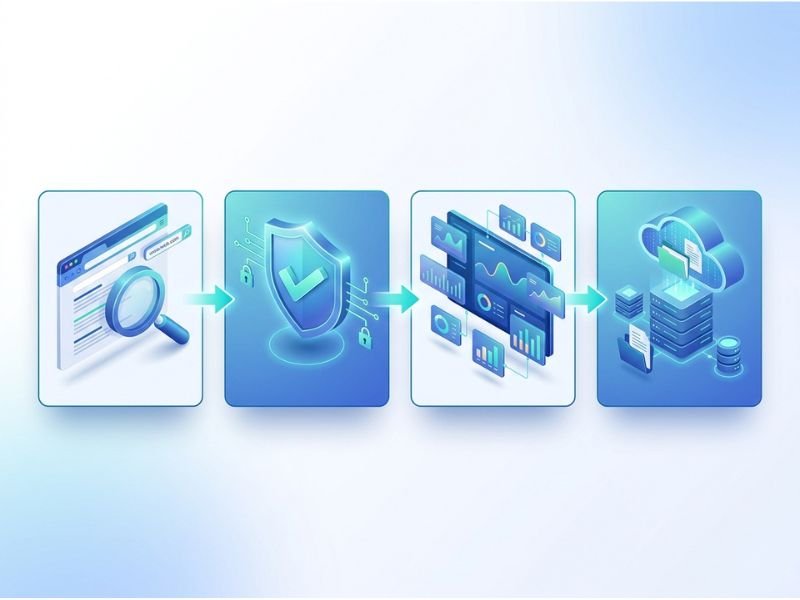
Find → Verify → Analyze → Record
Each step helps turn an uncertain website search into a reliable business research record.
What Is Target Company URL Research?
Target company URL research is the process of finding the official website of a specific business and confirming that the domain actually belongs to that company. It combines website discovery with company identification and verification.
For instance, consider that you are searching for a company by the name of Example Technologies. You can get a number of websites with similar titles. Rather than choosing the first result, compare the business title, its location, services, contacts, and so forth.
| Company Name | Candidate Website | Verification Status |
| Example Technologies | exampletech.com (illustrative) | Verified |
| Example Technologies | exampletechnologies.net (illustrative) | Needs Review |
| Example Technologies | exampledirectory.com (illustrative) | Unverified |
Illustrative example only: the statuses demonstrate a research workflow and do not represent checks of real domains.
This distinction matters because company URL research is not simply a domain search. Finding a website is one step. Confirming that it represents the right business is another.
Target Company vs Target Corporation: What’s the Difference?
The phrase “target company” can create confusion because it may describe any business selected for research. The target company can be either a prospective candidate, competitor, employer, supplier, or a target for investments, among other entities undergoing investigation.
In contrast, Target Corporation is a specific U.S. retail company operating under the Target brand.
It is important to note the difference between these two notions while researching the target company. Someone researching a target company may have no connection to Target Corporation. Including additional characteristics like industry, city, country, or products will help to find more relevant information.
Why Is Company URL Research Important?
Good company website research starts with accurate company identification. A verified website gives researchers a dependable starting point for collecting business information.
Accurate Company Identification
Just the name of a company is not sufficient. There are businesses with identical names, multinational companies, or businesses with alternate trading names. Verifying the domain ensures that the research record corresponds to the intended business.
Better CRM Data
Sales teams often store company websites in CRM systems. Incorrect URLs can affect account records, enrichment, segmentation, and later research. Company URL verification helps keep those records cleaner.
More Reliable Sales Research
A verified website can reveal products, services, locations, industries served, and business priorities. This gives sales teams a stronger foundation for account research and outreach.
Correct Competitor Analysis
SEO and marketing teams need the correct domain before comparing competitors. An unrelated website can produce misleading keyword, content, traffic, and backlink data.
Recruitment and Employer Verification
Recruiters can use official websites to confirm company identity, careers pages, locations, and employment information before adding a business to their research list.
SEO Research
SEO teams frequently investigate competing websites. Before analyzing keywords or backlinks, they need to confirm the official company domain.
The basic problem is simple:
Wrong website → wrong company data → wrong conclusions
How to Perform Target Company URL Research
A reliable target company URL research process starts with basic identification and ends with a documented, verified result. The following steps work for individual companies as well as larger research projects.
Step 1 – Collect Basic Company Information
Before searching for a domain, collect as much identifying information as possible. Useful fields include:
- Company name
- Legal name
- Country
- City
- Industry
- Products or services
- Parent company, if applicable
For example:
| Field | Example |
| Company Name | Example Technologies |
| Country | Canada |
| Industry | Software |
| Website | Pending |
| Status | Researching |
This information makes it easier to separate similarly named businesses. It also creates a basic record before the website search begins.
When the business operates in multiple markets, note the relevant location. A company may have different regional sites, and the appropriate domain can depend on the purpose of your research.
Step 2 – Search for the Official Company Website
The next step is to find the official company website using focused searches. Useful search combinations include:
- company name + official website
- company name + country
- company name + industry
- company name + city
Do not automatically trust the first result. Search engines may display directories, social profiles, review platforms, news articles, marketplaces, or similarly named businesses before the actual company website.
Compare several results before selecting a candidate domain.
The goal of target company research URL discovery is not simply to find something that looks relevant. The goal is to find a domain connected to the exact business you intend to research.
Step 3 – Verify the Domain
Once you have a candidate website, compare information shown on the site with your original company details.
Check:
- Business name
- Logo and branding
- About page
- Location
- Contact details
- Products and services
- Legal information
- Privacy policy
- Copyright or company name
A practical company domain lookup should consider multiple signals rather than one matching detail. You can also consult ICANN Registration Data Lookup for domain registration information, although privacy protection and registrar data do not by themselves establish company ownership.
| Verification Signal | Reliability |
| Matching legal company information | Strong |
| Matching company address | Strong |
| Matching products/services | Strong |
| Official social profiles linking to domain | Strong |
| Similar company name only | Weak |
| Third-party directory listing | Supporting evidence only |
For company website research, several matching signals provide much stronger evidence than a similar domain name alone.
Step 4 – Check Independent Sources
First-party information is useful, but important details should sometimes be checked against independent sources.
Possible sources include:
- Government or company registries, such as Canada’s Business Registries
- Annual reports
- Regulatory filings, including SEC EDGAR company filings for relevant U.S. filers
- Reputable news publications
- Official social profiles
- Trusted industry directories
A first-party source is information published by the company itself. An independent source comes from outside the organization. Official social profiles are company-controlled first-party channels, not independent confirmation.
Evaluate each source according to what it can reliably confirm. While the company’s official website will supply up-to-date information regarding its services and locations, the external sources will prove to be useful in identifying the organization.
This is especially necessary in case the company has undergone some changes such as name change or mergers, among others.
Step 5 – Record the Verified Result
The final step in target company URL research is documentation. Do not simply copy a URL into a spreadsheet and move on.
Record:
- Company name
- Official domain
- Regional domain
- Source used for verification
- Verification status
- Date checked
- Research notes
A date is especially useful because websites and corporate structures can change. Keeping the verification date makes the record easier to review later.
How to Verify Whether a Company URL Is Official
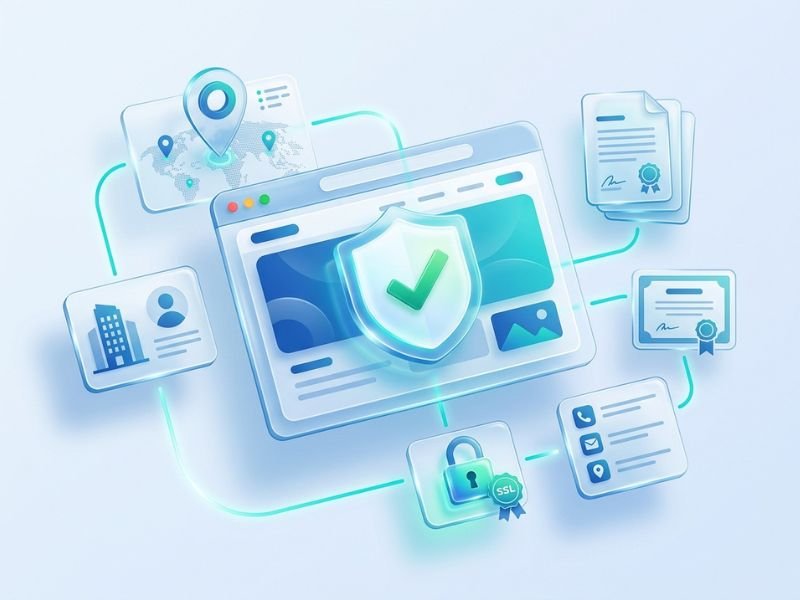
Company URL verification should be based on several pieces of evidence. A professional business website verification process can use this checklist:
- Does the company name match?
- Does the location match?
- Do products or services match?
- Does the About page describe the same business?
- Does contact information match?
- Do official social accounts link to the website?
- Is legal or company information available?
- Does the site redirect to another domain?
- Does the domain appear current and actively maintained?
After reviewing the evidence, assign a simple status.
Verified
Strong evidence connects the website to the intended company.
Needs Review
Several details match, but there is still some uncertainty. More evidence should be checked before treating the URL as confirmed.
Unverified
There is not enough reliable evidence to establish that the domain belongs to the intended business.
This approach keeps target company research organized without forcing uncertain results into a confirmed category.
How to Handle Difficult Company URL Matches
Some businesses cannot be identified through a simple name search. Company website research becomes more important when several possible domains appear.
Companies With the Same Name
Use additional information to separate businesses with identical or similar names. Compare:
- Country
- City
- Industry
- Products
- Services
A company name should be treated as one identifier, not complete proof of identity.
Parent Companies and Subsidiaries
A subsidiary may have its own website, while another division operates under its parent company’s domain. Check these corporate relationships before recording the URL.
Rebrands and Acquisitions
A business may continue receiving traffic to its former domain after rebranding. Check redirects, acquisition announcements, and former company names.
Review the Google Search Central site-move guidance to understand how domains can change. A redirect alone is not definitive proof of company identity. This can prevent an old website from being incorrectly marked as the current official company domain.
Regional Domains
A business may use:
- company.com
- company.ca
- ca.company.com
- company.com/ca/
The appropriate website address depends on your research purpose. For international research, you can use the general corporate site address, while for regional research, you can use the website specific to that region.
Target Company Research via URL
Target company research via URL begins after the official website has been verified. The URL becomes the starting point for gathering information about the business.
About Page
An About page can include the history of the company, its positioning, leadership profile, and other organizational information.
Product/Service Pages
These pages indicate the product and services offered by the company, target market for the products/services, and positioning of the offerings.
Careers Page
A career section can provide information on job openings, organizational units hiring people, locations, etc.
Newsroom
News pages can highlight the partnerships made, acquisitions completed, product launches, expansion plans, awards, etc.
Investor Relations
This section is for public companies that disclose financial information and other information to investors.
Contact and Location Pages
These pages can help confirm offices, operating regions, phone numbers, and business locations.
In this way, target company research via URL moves beyond finding a domain. The verified website becomes the starting point for deeper business research.
Target Company URL Research for Sales Research Analysis
Target company URL sales research analysis can help sales teams build a clearer picture of potential accounts before contacting them.
A verified website can provide information about:
- Target accounts
- Business model
- Products and services
- Operating locations
- Growth signals
- Potential business needs
- Decision-maker information
For example, a sales researcher can start with a target account, confirm its website, review its services, identify relevant business developments, and then personalize outreach.
A simple workflow is:
Target Account → Verified URL → Company Analysis → Decision Makers → Personalized Outreach
The relevance of outreach depends partly on the accuracy of the research behind it. That makes target company URL research useful during the early stages of account preparation.
Using Company URLs for SEO and Competitor Research
Verified domains are essential for competitor research because SEO tools analyze the website you provide.
Once the correct URL has been confirmed, marketers can use Ahrefs Site Explorer or similar tools to investigate:
- Competitor keywords
- Backlinks
- Organic traffic
- Content gaps
- Top-performing pages
- SERP visibility
- Competitor changes over time
A company domain lookup should therefore happen before entering a competitor into an SEO platform. If the wrong domain is selected, every later comparison can be affected.
The same principle applies to company URL research for content planning. The correct website gives marketers a more accurate view of what a competitor actually publishes and which pages support its search visibility.
Manual vs Automated Target Company URL Research
Automation can make large-scale target company URL research much faster, but it does not remove the need for human judgment.
| Factor | Manual Research | Automated Research |
| Speed | Slower | Faster |
| Bulk research | Limited | Excellent |
| Ambiguous companies | Better | Can make mistakes |
| Context understanding | Strong | Limited |
| Scalability | Low | High |
| Final verification | Strong | Human review recommended |
Manual research is useful when company names are ambiguous or corporate structures are complicated. Automated systems are valuable when hundreds or thousands of records need initial processing.
A practical approach is to use automation for discovery, filtering, and preliminary matching, then use human review for final company URL verification.
Use automation for discovery and humans for final verification.
Common Target Company URL Research Mistakes
Even a basic target company research process can produce poor results when researchers skip verification.
Common mistakes include:
- Choosing the first Google result
- Treating a business directory as the official website
- Ignoring regional domains
- Confusing a subsidiary with its parent company
- Missing a recent rebrand
- Blindly trusting automated matches
- Failing to verify company location
- Saving a URL without a verification date
- Not documenting the evidence behind the decision
Another common issue is relying on a similar company name as the only proof. A domain can look convincing while belonging to a completely different business.
Good business website verification uses several matching signals. The more ambiguous the company, the more evidence should be reviewed before the URL is marked as verified.
Target Company URL Research Checklist
Use this checklist before adding a company website to your final research database:
- Correct company name confirmed
- Correct country confirmed
- Correct industry confirmed
- Products or services match
- About page reviewed
- Contact information checked
- Official social profiles checked
- Parent or subsidiary relationship checked
- Redirects reviewed
- Verification source recorded
- Verification date recorded
This simple checklist makes company URL research more consistent and easier to audit later.
Final Thoughts
Target company URL research is not simply about finding a domain. The real goal is to identify the correct official website, verify it using reliable evidence, analyze the business, and record the result properly.
A verified URL can support sales research, recruitment, SEO, competitor analysis, and broader market research. It also reduces the risk of building an entire research record around the wrong company.
Whether the work is performed manually, with automation, or through a combination of both, the same principle remains useful:
Find → Verify → Analyze → Record
FAQs
Q1. What is target company URL research?
Target company URL research is the process of finding and verifying the official website of a specific business. It involves comparing company information, checking the domain against reliable sources, and recording the verified URL for sales, SEO, recruitment, competitor, or market research.
Q2. How do I find the official website of a company?
Start with the company name and add identifying information such as its country, city, industry, or products. Search several results rather than automatically selecting the first one. Then compare the candidate website’s branding, location, services, contact details, and company information.
Q3. How can I verify that a company URL is official?
Compare the website with multiple company identifiers. Check the business name, address, products, services, contact information, legal details, and official social profiles. Independent registries, filings, and reputable publications can provide additional confirmation when the company’s identity is unclear.
Q4. What is target company research via URL?
Target company research via URL means using a verified company website as the starting point for business research. Researchers can review About pages, products, services, careers, news, locations, and investor information to build a more complete understanding of the organization.
Q5. Is a target company the same as Target Corporation?
No. A target company is any business selected for a particular research purpose. Target Corporation is the specific U.S. retail company. Context such as industry, location, country, and products helps distinguish a general research target from that specific corporation.
Q6. Can target company URL research be automated?
Yes. Software can help discover candidate domains, process large datasets, and identify possible matches. However, automated systems can struggle with similar company names, subsidiaries, rebrands, and regional domains. Human review is recommended before uncertain URLs are treated as verified.
Q7. How do I find company URLs in bulk?
For bulk work, begin with a structured company list containing names, locations, industries, and other identifiers. Automated discovery can generate candidate URLs, while validation rules and human review can confirm difficult matches. Store the URL, verification status, evidence, and date for each record.
Q8. What should I do if two companies have the same name?
Compare their country, city, industry, products, services, addresses, and other identifying details. Review each candidate website separately. Do not select a domain based only on the matching name. If evidence remains unclear, mark the record as needing review.
Q9. Should I use the global or regional company website?
It depends on the purpose of the research. A global website may be more useful for corporate research, while a regional domain or country section can provide better information for local sales, SEO, recruitment, or market analysis.
Q10. How does company URL research help sales teams?
A verified URL gives sales researchers a reliable source for understanding a target account’s products, services, locations, customers, and business developments. This information can support account planning and help sales teams create outreach that reflects the prospect’s actual business context.
Q11. How can company URLs help with SEO competitor research?
A verified competitor URL allows SEO teams to analyze the correct website for keywords, backlinks, content, rankings, top pages, and search visibility. Competitor research becomes less reliable when the selected domain belongs to another company or an unrelated business.
Q12. How often should company URLs be rechecked?
Recheck URLs according to how frequently the research database changes. High-value sales or competitor records may need more frequent reviews. Also recheck websites after acquisitions, rebrands, mergers, domain changes, or major corporate restructuring.