
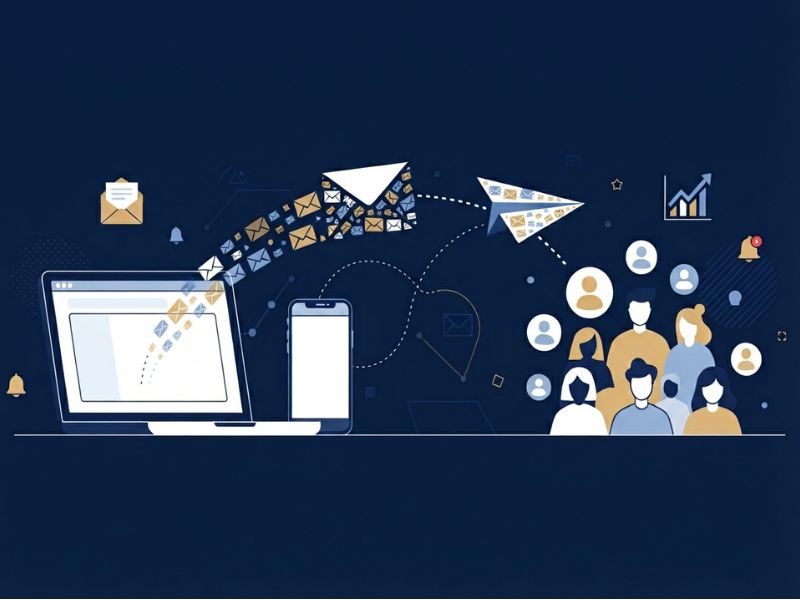
What Is Email Marketing? The Complete Beginner’s Guide
Email marketing is one of the most potent digital marketing channels available today. Despite changes in social media sites and changes in search engine algorithms, with email marketing, you have direct access to your customers. If you have an online store, a SaaS platform, or a business providing local services, email marketing can help you establish relationships with customers and grow your sales.
Unlike paid advertising, with email marketing, you always own your mailing list. Algorithm changes and rising ad costs don’t affect your ability to reach them. You can contact your customers anytime. Through an email marketing campaign, you can cultivate your leads, get back your old customers, introduce new products and encourage repurchases from the customers.
This guide will explain all the basics of email marketing in 2026. You will learn what email marketing is, why it produces incredible results, types of campaigns, and how to create an email marketing strategy for your business.
What Is Email Marketing?
Email marketing is a form of digital marketing that uses email to communicate with prospects, subscribers, and customers. Companies provide informative, promotional, educational, or other relevant material directly to people who have chosen to be part of the mailing list.
Unlike any other digital email marketing strategy, email marketing does not reach randomly selected people but those who have been interested in your company in some way or another. They might be your subscribers because they subscribed via your website, downloaded something for free, bought your product or joined your mailing list.
Today’s email marketing is much more than sending bulk emails. Email marketing automation, segmentation, behavior analysis, and personalization help companies today deliver highly relevant emails that result in better interaction with customers and higher conversion rates.
The use of effective email marketing campaigns may assist in doing many things for a business such as:
- Increasing brand recognition
- Establishing client trust
- Generating qualified leads
- Increasing sales
- Customer retention
- Encouraging repeat purchases
- Recovering abandoned carts
- Promoting new products and services
How Email Marketing Works
Fundamentally, email marketing is a very basic procedure. First, a prospect subscribes to your mailing list; next, he or she is communicated with in a way that provides value; finally, they become increasingly closer to becoming your client.
Step 1: Collect Permission Through Opt-In
The first step to any successful campaign is getting permission.
Prospects sign up after filling out an opt-in form on your website, landing page, blog, checkout page, or lead magnet. They give you their email address voluntarily in anticipation of receiving value.
Here are some incentives for opting in:
- Free ebooks
- Discount codes
- Special offers
- Product news
- Newsletter subscriptions
- Webinars
- Templates
- Checklists
Building a permission list increases engagement while decreasing spam complaints.
Step 2: Organize Your Subscribers
Not all customers have similar interests.
Companies segment their market into small segments on the basis of criteria like:
- Purchase behavior
- Location
- Interest
- Activity on the website
- Industry
- Customer lifecycle stage
- Past email interaction
This practice is known as segmentation.
Step 3: Create Valuable Emails
The following phase involves creating content that the audience would be willing to engage in.
Based on your objectives, you may consider using:
- Educational articles
- Announcements for your products
- Promotions
- Seasonal promotions
- Company updates
- Success stories of your clients
- Invitations for events
- Recommendations
Value should always precede promotion. Companies that help their subscribers build trust create stronger relationships over time.
Step 4: Send Emails at the Right Time
Timing is an essential element of campaign success.
Today’s modern email marketing platform provides organizations with the opportunity to schedule their emails according to the activities of their subscribers, rather than sending them immediately.
These types of email messages can be:
- Sign up confirmation email
- Order confirmation
- Birthday emails
- Cart abandonment notification
- Renewal reminder
- Product follow-up emails
Step 5: Measure Performance
Every marketing campaign offers many lessons to be learned.
The following are some of the performance measures that are analyzed:
- Open rate
- Click-through rate
- Conversion rate
- Bounce rate
- Unsubscribe rate
- Amount of revenue generated
- Subscriber Growth
This analysis helps optimize future marketing campaigns.
Why Email Marketing Still Matters in 2026
Despite all the expectations of marketers, emails were not supposed to last for a very long time on the earth’s surface; however, it has become one of the most reliable methods of marketing available.
Most internet users check their inbox regularly for work-related messages, news about sales, notifications, newsletters, and even offers. As such, companies can communicate directly without depending solely on the help of search engines or social media sites.
Exceptional Return on Investment
Email provides one of the best returns on investment in the field of digital marketing. While paid marketing requires spending money to attract customers by clicking ads or opening pages, email allows companies to keep growing the relationship with customers after subscribing without much additional expenditure.
Small business owners can earn significant money using their email marketing strategies.
Better Audience Ownership
The algorithms of social media are always evolving.
Today, a post could reach thousands of followers but in the future, it will reach only a very small fraction of the audience.
Using email marketing, you have control over your subscribers. As long as they are still subscribing, then you have full access to communicate with them.
That is why email marketing is one of the best investments to make in the world of marketing.
Improved Personalization
The modern email service providers use customer data to provide personalized email marketing services.
In place of providing similar emails to all the customers, the businesses can tailor the email message depending upon the activities, preferences, past purchase history, and even browsing history of the customer.
Advanced Automation
Email marketing can now be highly automated. It is now possible for companies to build automated full customer journeys after one subscribes to an email list, downloads a brochure, buys a product, or even visits a particular page.
Strong Deliverability Improvements
There have been many advancements in email technology over the last few years. SPF, DKIM, and DMARC are authentication standards that assist businesses in sending emails to inboxes efficiently without any spamming attempts.
However, when marketers adhere to best practices and keep their subscribers healthy, there is no issue with deliverability.
Supports Every Stage of the Customer Journey
Email marketing is effective throughout the whole sales process.
It allows companies to:
- Introduce the brand to new visitors
- Educate prospective customers
- Establish trust via valuable content
- Make customers purchase for the first time
- Up-sell existing clients
- Create loyalty among customers
- Generate repeat purchases
- Reactivate non-active subscribers
Few marketing tools provide such an opportunity to help at each point of the customer life cycle.
Works Alongside Other Marketing Channels
Email does not substitute for SEO, paid advertisements, or social media marketing.
Rather, email augments every other email marketing strategy.
Examples include:
- SEO attracts visitors to your website.
- Paid advertisements bring in leads.
- Social media enhances visibility.
- Email develops those leads into customers.
Such an approach makes up a sustainable digital marketing model that keeps working overtime.
The use of Email will help create stronger relations with customers as well as leverage every visitor to your website.
Types of Email Marketing Campaigns
All Emails are not used for the same purpose. Emails could be used to welcome the newly subscribed customers or to motivate people to make purchases or educate customers and nurture long-term relations between companies and their consumers.
Companies with best performance use a combination of many different types of Email campaigns rather than using just one single type of an Email campaign.
Newsletters
Newsletters are among the most popular ways of doing email marketing. The use of newsletters helps the businesses stay in contact with their subscribers through informative content.
Apart from the promotion of a business and its services, newsletters provide added value by offering educational information, insights into the industry, company news, product advice, success stories of other customers, etc.
There are many elements that can be included in an effective newsletter such as:
- Latest blog posts
- Industry news
- How-to guides
- New products or services
- Upcoming events
- Success stories
- Seasonal advice
- Special offers for subscribers
For instance, a fitness business can send newsletters containing workout tips, healthy food recipes, and success stories of other customers. An online software provider can send productivity tips along with news about new features.
Best Practices for Newsletters
How can you increase engagement?
- Have a consistent sending schedule.
- Create engaging subject lines.
- Use short paragraphs.
- Have only one call-to-action.
- Always add value first and then the product promotion.
- Ensure that each email is optimized for mobile.
Your subscribers will be way more interested in staying on your list when each newsletter educates them.
Promotional and Sales Emails
The main aim of promotional email is to prompt instant action. The promotion campaign can feature products, services, special discounts, time-bound offers, or news.
As compared to newsletters, promotional emails have more sales orientation but they need not be pushy; they must add some value.
Popular promotional campaigns are:
- Product launch
- Flash sale
- Holidays sale
- Coupon code
- Special discounts
- Free shipping
- Seasonal collection
- Packages
The successful promotional email gives reasons for the offer and creates urgency without seeming deceitful.
For instance, a retail shop offering clothes online may send an email announcing a weekend sale with a discount, images of the products, and a “Buy Now” button.
An application development company may send a promotional email for its yearly subscription offer that is about to expire.
Tips for Better Promotional Emails
Successful sales emails should have the following elements:
- Compelling subject line
- Benefits of the product
- Visuals
- Call-to-action button
- Urgency
- Mobile-responsive layout
Instead of bombarding your audience with several deals, limit yourself to just one goal per campaign.
Transactional Emails
Transactional emails are automatically sent when the customer performs a particular task.
Some examples are:
- Order confirmation emails
- Delivery notifications
- Payment confirmation emails
- Emails to reset passwords
- Verification emails
- Confirmation of bookings
- Subscriptions expiration or renewal emails
Since people actually look forward to receiving these kinds of emails, transactional emails usually generate higher open rates than regular marketing emails.
Even though their main function is informative in nature, companies have the opportunity to enhance the customer experience through recommendations or complementary products in addition to the information provided.
For instance, an order confirmation email for a pair of running shoes can suggest related products like socks.
Drip and Nurture Email Sequences
Drip marketing is a series of automated emails that is scheduled to be delivered automatically over time based on certain criteria.
Rather than sending out one email, companies send a whole series of emails that educate and instruct their subscribers into taking some form of action.
Common uses for drip marketing include:
- Onboarding new subscribers
- Nurturing leads
- Educating customers about products
- Onboarding free trials
- Providing online classes
- Customer onboarding
- Event registration
- Subscription renewal
Your welcome sequence could be something along these lines:
Day 1: Welcome and introduction
Day 3: Educational value added
Day 6: Success stories from other customers
Day 9: Product demo
Day 12: Time-sensitive offer
Each email is logically consistent with the previous one, giving your subscribers enough time to build their trust in you before making any sales pitch.
Re-Engagement and Win-Back Emails
All email lists have inactive users. There are subscribers who don’t open emails anymore due to the change in their interests or just because they are too busy.
Win-back campaigns serve to bring back subscribers before they are deleted from the list.
Typical win-back campaigns are:
- Discounts
- Recommendations
- News about products
- Exclusive information
- Surveys
- Preference changes
- “We miss you” campaigns
For instance:
“We see that you haven’t been visiting us lately. So here’s a 20% discount for your next order.”
Other campaigns may be related to asking subscribers if they want to continue receiving emails.
List cleaning will not only improve deliverability but will guarantee that future campaigns will target only interested subscribers.
Benefits of Email Marketing for Businesses
Why do companies keep on spending money on email marketing? Because this form of marketing yields tangible results in almost all industries. Whether you wish to generate more revenue, build better relations with customers, or increase their loyalty, email marketing is one of the most reliable marketing mediums.
Here are some of the most important benefits.
Lower Cost Compared to Other Marketing Channels
Marketing budgets are very important, particularly for start-ups and small business firms.
With paid advertising, once the budget is finished, the traffic will be gone too.
However, with email marketing, this is not the case.
Once you have created a list of subscribers, you are able to continue sending emails to them even though your budget is already exhausted. Almost all email providers provide cheap prices depending on the number of subscribers, therefore making email marketing easy for businesses of all sizes.
They can do the following things:
- Decrease the cost of acquiring customers
- Increase repeat purchases
- Create revenue continuously
In many cases, email marketing becomes one of the most productive expenses in the digital marketing plan of businesses.
You Own Your Audience
Among the best aspects of email marketing is its ability to have audience ownership.
Social media followers belong to the platform itself.
Search engine rankings may get affected by each algorithm update.
Advertising rates keep rising on numerous digital platforms.
The email list of your subscribers, on the other hand, is a direct mode of communication that is under your control.
As long as your subscribers are interested and permission is kept in place, you can communicate without relying only on third-party platforms.
Better Personalization Through Segmentation
The current generation of consumers expects personalization.
The lack of personalization often causes low engagement in generic emails since they don’t align with individual preferences.
Through segmentation, organizations can break down their subscribers into smaller segments using criteria including:
- Purchasing history
- Web behavior
- Location
- Preferences
- Loyalty levels
- Stage of the customer lifecycle
- Email becomes more targeted.
For instance, a pet store website won’t advertise cat products to users who only buy dog products.
In contrast, each subscriber will receive relevant content based on their past behavior.
A higher relevance means:
- Improved open rates
- Increased clicks
- Greater conversions
- Customer loyalty
- Lower unsubscribes
Personalization does not just include calling your customer by his/her name. The business can offer recommendations, education, and even relevant offers depending upon the customer’s actions.
Once your subscriber feels understood, it becomes easy for them to participate in your marketing campaigns.
Strong Customer Relationships
Email marketing fosters conversation rather than transaction.
Constantly keeping in touch helps the company educate their customers, give answers to their questions, present new products, and mark significant achievements.
Through regular contact, the company manages to create trust and familiarity among its customers.
Those who receive valuable information on a regular basis will come back again and refer the company to other people.
It’s better to nurture existing relationships instead of constantly trying to find new clients.
Easy Performance Tracking
Unlike most conventional forms of marketing, email marketing gives information on how the process is performing.
The business can measure:
- Open rate
- Click-through rate
- Conversion rate
- Money made
- Unsubscriptions
- Bounce rate
- Growth in subscribers
This information enables businesses to continuously improve.
A slight change in the subject line, call to action, format of the email, and segmentation of the target audience can greatly increase future success.
Through time, this process helps businesses learn how to better do email marketing.
How to Build an Email Marketing Strategy
Before even thinking about creating a subject line, the success of an email marketing campaign is determined by having a well-thought-out and planned email marketing strategy, aligned with the objectives of your business and the target audience targeted.
There’s no need to complicate things when developing your own email marketing strategy. Start with basic principles, make them better with data, and keep on testing as your list grows.
Setting Goals
Every campaign must have an objective. Lack of goals may make it difficult for one to determine whether he/she is getting results out of his/her efforts via email marketing.
Prior to sending out the first email, one should consider asking himself/herself:
- “Do I wish to have more subscribers?”
- Is it my goal to increase my online sales?
- Do I want more traffic on my site?
- Am I targeting customer retention?
- Am I looking to launch a product or service?
- The objectives will guide the entire campaign.
Below are some business objectives and the type of campaigns used to achieve them:
| Business Goal | Recommended Campaign |
| Grow subscribers | Lead magnets, newsletter Sign Ups |
| Increase sales | Promotional campaigns |
| Recover lost sales | Abandoned cart emails |
| Build customer loyalty | Educational newsletters |
| Improve retention | Customer nurture sequences |
| Generate referrals | Referral campaigns |
Identify one main objective per campaign. Attempting to meet many goals through the use of an email will lower its efficiency.
As your business progresses, always reassess your objectives. Consumer behavior will change, and your approach via email should adapt accordingly.
Choosing the Right Tool or Platform
Software selection will play a key role in determining your success. The contemporary emailing platforms provide much more than just sending out emails.
Features like:
- Drag and drop email editor
- Email automation
- Segmentation of your target audience
- Personalization of emails
- Dashboards for analyzing results
- Landing pages creation
- Sign up forms
- A/B testing
- CRM integration
- E-commerce integration
Will depend on your business requirements and budget constraints.
For instance:
- SMEs will like simple solutions with easy deployment.
- Online shops will be in need of powerful e-commerce automation.
- B2B firms will be in need of CRM integration and lead scoring.
- Growing firms will require scalability and automation.
Do not select software based only on pricing.
List Building Basics
One of the most valuable assets for any business is the email list. When done right, your list can help you get more engagement and conversions.
Do not buy email lists.
People who have not opted in are unlikely to engage. The purchase of email lists often turns out to be complaints of spamming.
Grow your list naturally.
Some of the popular methods of list building are:
Offer Valuable Lead Magnets
Provide people a reason to sign up.
Here are some ideas:
- Ebooks
- Templates
- Checklists
- Industry Reports
- Discount codes
- Free Shipping
- Training Videos
- Special Resources
It should be relevant to your target audience.
Create Simple Sign Up Forms
Put the sign up forms in places where users will naturally engage with your website.
Typical places are:
- Homepage
- Blog post
- Sidebar
- Footer
- Landing pages
- Checkout page
- Pop-ups
- Exit Intent form
Use short forms that ask for nothing more than the user’s name and email address.
Use Strong Calls to Action
Rather than:
“Subscribe to our newsletter.”
Do:
“Sign up for our weekly marketing tips that will help you grow your business.”
It’s good to mention the benefits.
Maintain List Quality
Building the list is an important process, but keeping the quality of the list is just as important.
Remove regularly:
- Invalid Email addresses
- Hard Bounces
- Inactive users for a long period of time
- Spammers
A smaller audience that engages is more likely to perform better than a large inactive list.
Measuring Success
Marketers that succeed don’t guess.
They measure.
Knowledge about your performance will make you understand which strategies work and which need improvement.
Some of the key email marketing metrics include:
Open Rate
Open rate refers to how many people opened your email.
Some factors affecting the open rate are:
- The subject line
- Sender reputation
- Audience engagement
- Time sent
- Branding awareness
Though there have been changes due to privacy updates about how open rates are measured, they can still be helpful in giving a sense of direction when used along with other metrics.
Click-Through Rate (CTR)
CTR shows what percentage of your email subscribers clicked on a link within your email.
Having a high CTR is a sign of:
- Relevant content
- Effective calls to action
- Well-designed emails
- Right audience targeting
If subscribers open the emails but don’t click on links, then you need to change your content or make your offer simpler.
Conversion Rate
Conversion rate indicates how many people did the required thing after clicking on something.
Examples are:
- Buying a product
- Making a booking appointment
- Downloading the guide
- Event registration
- Free trial
It is one of the most valuable metrics because it directly shows results for the company.
Additional Metrics Worth Monitoring
Monitor:
- Bounce Rate
- Unsubscribe Rate
- Spam Complaints
- Revenue per Email
- Subscription Growth
- Email Sharing
- Forwarding Rate
Checking all these figures regularly will make your future campaigns better.
Real Email Marketing Examples That Work
Leveraging email marketing examples from real-world campaigns helps one better understand how an effective email marketing strategy operates.
The following are four email marketing examples that companies in various industries use.
Welcome Email Marketing Examples
Welcome emails are those that allow a business to connect with new customers right from when they sign up.
This is because the email is able to create a good first impression and build expectations for the future.
Email marketing examples can be:
Subject line: Welcome! We’re So Happy You Joined!
Email body:
Hi Sarah,
It is great having you in our community.
Our aim is to help you learn how to implement effective email marketing strategy to expand your business.
In the following weeks, we will send some valuable insights and useful resources that you can use to succeed.
Enjoy your FREE Digital Marketing Checklist as a welcome gift.
Download Now →
Join us today.
Marketing Team
How this works:
- Immediate delivery
- Friendly approach
- Good expectations
- Great first offer
- Single call to action
Abandoned Cart Example
Many consumers put their goods into the shopping cart and abandon them there.
The purpose of an abandoned cart email is to prompt them to come back before losing the opportunity.
Subject Line: You Left Something Behind
Email Body:
Hello, James!
Your chosen products are still waiting for you!
Make your purchase right now or lose them forever.
What are you waiting for?
Get a 10% discount with the coupon code SAVE10!
Back to cart →
See you soon!
How it works:
- Personalized message
- Time-sensitive
- Incentive included
- Clear CTA
Even one abandoned cart sequence can bring back a lot of potential clients.
Newsletter Example
Newsletters concentrate on nurturing relationships rather than sales.
Example:
Subject Line: This Week’s Marketing Tips
Inside this week’s newsletter:
SEO Trends for 2026
- How AI Helps with Email Personalization
- Content Planning Template Freebie
- Success Stories of the Week
- Registration for Upcoming Webinar
- Read This Week’s Newsletter →
You deliver useful information while keeping a connection with your subscribers at the same time.
Promotional Email Example
Promotional emails prompt the recipients to take full advantage of a specific offer.
Example:
Subject Line: Last Chance! Summer Sale Ends Tonight
Hi, Emma,
“Our biggest seasonal sale ends in just a few hours.” reads more natural.
Enjoy discounts of up to 40% on selected collections.
Visit the Sale Page →
Thanks for your choice!
Its strong points:
- Clear offer
- Limited time element
- Simple message
- Good call-to-action
- Mobile version available
A promotional campaign requires a balance with the informative one. Otherwise, after some time, all emails will get boring.
Common Email Marketing Mistakes to Avoid
The best email marketing softwares will not help you to succeed if there are flaws in your strategy. In fact, many organizations spend much time trying to send more emails rather than work on their relevance and quality.
You can save yourself from these mistakes in order to gain more trust and create greater engagement.
Poor Segmentation
Sending the exact same email to every single subscriber is among the major email marketing mistakes that people make.
The target audience is not made up of similar individuals. Each individual has his or her own preferences and expectations.
For instance, the message for a new visitor will not be the same for an old and frequent customer. Some factors that you can use to segment your email list include:
- Purchase history
- Interests
- Geographical location
- Behavior on website
- Stage in the customer life cycle
- Email engagement history
Ignoring Mobile Optimization
Most people tend to view emails via their phones before they open their emails using desktop computers.
If the emails you send out cannot be easily viewed via mobile phones, the recipients will have difficulty reading the content and clicking the buttons.
For improving mobile experience, you should:
- Send responsive emails
- Keep the subject lines short
- Write short paragraphs
- Make sure that the buttons can be tapped easily.
- Use legible fonts
- Optimize images for faster loading
- Maintain sufficient white space for readability
Always preview your email before sending to desktop and mobile versions.
Using Spammy Subject Lines
Your subject line will be responsible for deciding whether you will get a response or not.
Do not use misleading or highly promotional language in an attempt to increase your open rate.
Here are some email marketing examples of bad subject lines:
- ACT NOW!!!
- FREE MONEY!!!
- You Won’t Believe This!!!
- Guaranteed Winner
- Limited Offer!!!!! Click Now
On the other hand, here are some good email marketing examples:
- Your Weekly Marketing Tips Are Here
- Five Ways to Increase Customer Retention
- Complete Your Purchase Before It’s Gone
- New Features We Heard You Want
Neglecting Deliverability Best Practices
Despite your efforts to create top-notch emails, all those efforts will be of no avail unless those emails find themselves in the inbox.
To ensure good deliverability, do the following:
- Use permission-based email lists.
- Remove dormant subscribers regularly.
- Employ SPF, DKIM, and DMARC authentication for your domain name.
- Don’t buy email lists.
- Keep track of spam complaints.
- Send emails consistently.
Always test your campaigns before sending.
Sending Too Many or Too Few Emails
Getting the ideal frequency requires testing.
Sending more than one promotion email per day may cause your subscribers to feel overwhelmed.
On the contrary, sending emails after many months could make them forget about your company.
Consistency is key when setting up a proper schedule for email campaigns.
This could be done either on a weekly basis, every two weeks or monthly.
Frequently Asked Questions
What’s a Good Open Rate for Email Marketing?
The open rate you should aim at depends on your particular industry, audience, and campaign types. Rather than comparing your statistics to those of all companies, focus on how well your numbers have improved from month to month.
Pay attention to the quality of your subject lines, your list, its segmentation, and your emails’ relevance. The engagement of your subscribers is the best measure of your performance rather than achieving certain goals.
Is Email Marketing Relevant in 2026?
Yes, it still is. Email marketing in 2026 turns out to be one of the most effective digital marketing platforms.
The reason for businesses to pay attention to email marketing is that it allows them to gain access to the audience, automation, personalization, and results. Besides, unlike some social networks, one would not have to adapt to different algorithms in order to send emails.
How Frequently Should One Send Marketing Emails?
It depends on every particular business. Analyze key metrics to determine what works best such as open rates, CTR, and unsubscriptions in order to learn about the frequency of emails.
Is Email Marketing Applicable to Small Businesses?
Of course, it is. Email marketing is one of the cheapest ways that could be used to gain new clients and repeat purchases.
It is quite typical for companies to use weekly newsletters as well as to automate other emails.
What’s the Difference Between Email Marketing and Email Automation?
Email marketing refers to all the marketing campaigns sent to the subscribers either manually or automatically.
Automated email is one of the parts of the email marketing examples & its involves sending emails to customers based on their actions, such as subscription to a mailing list, abandonment of the cart or even purchasing a product.
Conclusion
Even today, email marketing remains to be one of the best ways for companies of all sizes to get in touch with their audience, develop customer relationships and make sure that every stage of the buyer’s journey is covered, from signing up to making additional purchases.
However, the main factor to succeed in such endeavors is not to send more Emails but to make sure that you send the proper message to the right person at the proper time. Implementing an Email marketing strategy which is based on permissions, valuable content, segmentations and analysis of the results of your campaigns will make sure that the strategy is successful for many years to come.
As your company continues growing, you will have an opportunity to continue improving subject lines and optimizing the campaigns according to performance metrics. Small but consistent improvements in these areas will bring good results in terms of engagement and conversions.
To start off, consider creating a basic welcome message, newsletter and even one automated campaign. After gaining sufficient experience in the area, you will be able to introduce more advanced techniques into your marketing strategy.