
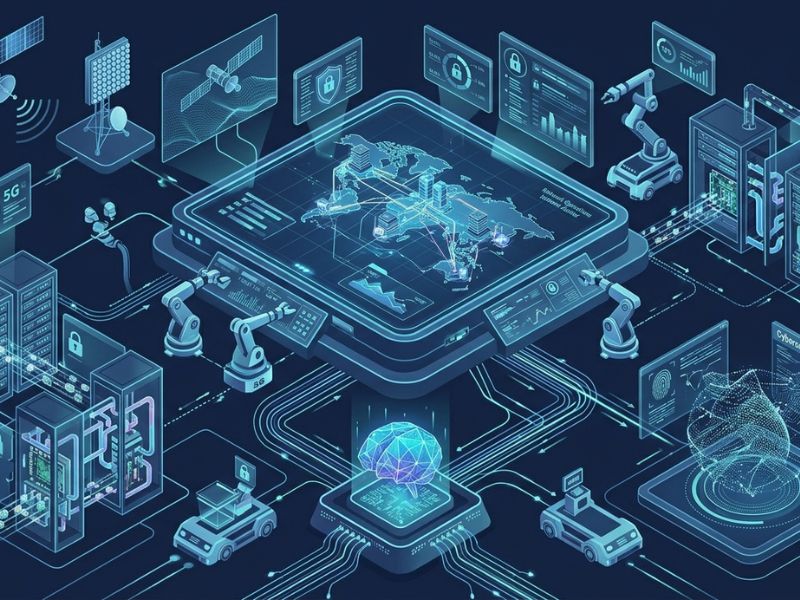
Artificial intelligence is changing the overall landscape. Ways of communication are becoming smarter and faster across the globe. In this evolving digital landscape, networking technology is the invisible backbone.
It facilitates communication, resource sharing, and information exchange across various professional and global landscapes.
Nowadays, its role has shifted from being ordinary to enabling cloud computing, the Internet of Things (IoT), and artificial intelligence.
In this guide, we will discuss how networking technology, and 5G networking are transforming the digital landscape.
The Numbers Tell You Everything You Need to Know
Over the last few years, the world has seen a demanding need for speed and reliability in networks.
Today, digital systems play a vital role for businesses. Cloud computing, AI & the IoT have resulted in a tremendous increase in data traffic. Once offices might only have a few connected devices; now, a dozen of them can be found there.
The networking technology market for global data centers is projected to rise from about US$ 46 billion in 2025 to over US$ 100 billion in 2030. Organizations depend on network infrastructure, thanks to the need for flexibility and growth.
No longer are companies upgrading networks for the mere sake of replacing aging hardware. Their upgrade is necessitated by the total transformation of work practices.
Wi-Fi 7 Is Finally Moving Past Early Adopters
Wi-Fi 7 is among these significant advancements that are here right now. The technology has existed for quite a few years now, but mostly in early testing. It is forecast to become widely available by 2026.
Due to efficiency over other standards, businesses are starting to implement Wi-Fi 7 оборудование.
The greatest benefit is multi-link operation. Devices can connect to multiple frequency bands simultaneously, thanks to this technology. This minimizes network congestion and increases connection stability in busy office settings.
For instance, Wi-Fi 7 will maintain a stronger and more reliable connection even when your employees are video calling, transferring files, and using cloud tools at once.
Another major improvement is speed. Wi-Fi 7 may reach up to 46 Gbps, theoretically speaking. Due to the speeds you require, it would be a considerable rise from earlier wireless generations.
Due to all these benefits, Wi-Fi 7 is the increasingly future-ready option chosen by many businesses upgrading wireless infrastructure.
5G Networking Is Not Just About Phones Anymore
People think of mobile internet on their smartphones when they hear about 5 G. However, the actual effect of 5G is taking place in business settings.
Many organizations are building new private 5G networks nowadays. These networks are intended for business use only and are not shared with any public mobile users.
Manufacturing, healthcare, logistics, and warehousing sectors already enable their victorious private 5G networks to power critical systems.
The primary advantage of 5G networking is low latency, resulting in speedier response times between devices.
Such as.
- Automated systems in warehouses can communicate instantly.
- Hospital monitoring devices can send patient information immediately.
- Factory robots can coordinate with each other without lag.
5G networking is increasingly becoming an essential part of digital infrastructure.
AI Is Running Networks Now, Not Just Monitoring Them
The functioning of networks is also changing through AI. In the past, manual network performance monitoring of issues was the responsibility of IT professionals.
AI-based tools can both automatically analyze network data and detect problems more quickly.
This technique is commonly referred to as AIOps or Artificial Intelligence for IT Operations.
Systems that use AI examine unusual traffic, predict outages, and reroute traffic automatically when problems develop. Oftentimes, the system fixes the problems before users even notice anything.
When the IT team’s manual workload is reduced, they can focus more on strategic work and not on firefighting.
However, when the networks are well-designed and updated, AI works better.
If you want help building that foundation properly, the team at BitCode Solution works with businesses to get their network infrastructure ready for where things are headed.
Zero Trust Is Not Optional Anymore
Another important change in networking technology is the switch to Zero Trust security.
Long ago, network security simply meant that once you were in the network, your trust was assumed. When employees only accessed systems from office locations, this model worked.
However, nowadays, employees work from home, airports, cafes, and many other places. Third-party vendors and cloud applications are necessary for businesses.
The old security model has become obsolete because of this.
Zero Trust has a distinct approach. Every access request should be verified instead of blindly trusting users.
That means systems check.
- Who has the request?
- Identify the device in use.
- From where the request is coming.
Zero Trust helps mitigate the risk of data breaches by constantly verifying user and device identities.
Network Resilience Is Now a Leadership Priority
Network resilience is yet another essential area of focus in technology development. Before, businesses focused on preventing cyberattacks or technical failures. The focus today is on keeping systems working when they experience problems.
Present-day networks are complicated. Firms have a tendency to make use of several cloud providers and have distant employees and items.
Because of this complexity, disruptions occur every so often. We need to design networks that can recover quickly and continue operating.
Businesses do this by installing redundancy systems, backup connectivity paths & automated failovers.
For practical guidance on building a resilient network architecture, Network World’s coverage of 2026 networking trends is worth reading. They cover the specific technologies and approaches enterprises are using this year.
The Businesses Getting Left Behind
Some entities are updating their networks, while others continue to use aged infrastructure.
Some firms still use older Wi-Fi standards, outdated security protocols, or restricted monitoring. Such businesses face more downtimes, more security risks, and slower operations.
Every year, the gap between the old networks and modern networks is increasing.
Fortunately, businesses do not have to overhaul all at once. You can upgrade and be intelligent, allowing a security boost and maximum performance.
If you’re designing a tech strategy, you should definitely check out our data security tools for modern businesses to bolster your entire digital infrastructure.
Working with people who understand both the technology and the business side makes the process much smoother. The team at BitCode Solution helps businesses figure out what their networks actually need and builds toward it in a way that makes sense for their specific situation.
Frequently Asked Questions
What is technology networking?
Networking technology refers to the devices and equipment that facilitate communication and data transfer between devices on a network. This can include your routers, switches, and wireless equipment.
What differentiates Wi-Fi 7 from the older versions?
Wi-Fi 7 is faster & the latency is lower compared to the older versions of Wi-Fi.
What are the uses of 5G networking?
Businesses have access to a network with the speed and reliability to connect devices with 5G networking. It is being used to establish smart factory systems, smart warehouses & for tracking systems in real-time.
Why do businesses require Networking Technology?
A business network creates systems manageable, productive, & less vulnerable to downtime.
What does the future of networking technology look like?
The future will bring wireless networks that are simple, smarter, & more secure in the cloud.
Wrapping Up
The world of networking technology is moving very fast. Businesses that rely on old networks may find their services impaired, insecure, and interrupted.
The future of digital infrastructure is Wi-Fi 7, 5G networking, AI-driven network management & also Zero Trust security.
Organizations needn’t upgrade everything at once. Nevertheless, it is becoming increasingly necessary to have a defined approach to network performance.
Businesses that invest in modern networking technology today will be better prepared for the demands of tomorrow.
