
Google Cloud revenue 2026 surged in the third quarter, but its parent company Alphabet faces a growing question: how much money must it spend now to keep up with demand for artificial intelligence computing? Results released on October 28 show that Google Cloud more than doubled sales while Alphabet recorded another quarter of negative free cash flow. The contrast is becoming central to the economics of the AI boom.
Alphabet reported Google Cloud revenue of $30.7 billion for the three months ended September 30, 2026, up 103% year over year from approximately $15.2 billion. Total Alphabet revenue rose 25% to $127.6 billion. Those figures come from Alphabet’s third-quarter 2026 earnings release filed with the U.S. Securities and Exchange Commission. At the same time, Reuters reported on October 28 and updated October 29 that the company posted roughly $9.1 billion in negative quarterly free cash flow as it expanded AI infrastructure.
Google Cloud revenue 2026: the growth behind the numbers
The cloud business was the clearest growth engine in Alphabet’s latest report. Google Cloud sales increased from $15.157 billion a year earlier to $30.709 billion in the September quarter. Its operating income also rose sharply, from $3.594 billion to $11.121 billion. That means the division is not simply recording more contracts: the results show substantially higher operating profit as well.
Alphabet attributed the growth to enterprise AI infrastructure, enterprise AI solutions and its existing cloud services. It also highlighted direct sales of systems built around its tensor processing units, or TPUs, as a meaningful contributor. TPUs are Google-designed accelerators used for some AI workloads, providing another avenue for companies to obtain computing power alongside conventional graphics-processor-based systems.
Those figures should not be read as saying that all Google Cloud revenue came from generative AI. The segment includes traditional infrastructure and platform services, which Alphabet also cited as contributors. What the report does show is that demand from organizations building and operating AI applications is now significant enough to reshape the cloud division’s growth profile.
Why Alphabet’s cash flow turned negative
The spending side of the story is equally striking. Alphabet recorded approximately $9.07 billion of negative free cash flow in the quarter, compared with a $5.9 billion outflow in the preceding quarter, according to Reuters. The latest figure reflects spending to expand data centers, computing capacity and the systems needed to deliver AI products at scale.
Reuters reported that Alphabet’s capital expenditure reached around $51.4 billion in the quarter. Capital expenditure is not the same as an immediate accounting loss: it can create assets that support services for years. Nevertheless, the cash must be committed before customers generate enough incremental receipts to justify it. That timing mismatch can put pressure on even a fast-growing technology business.
It is important to distinguish negative free cash flow from negative earnings. Alphabet remained profitable overall. Its third-quarter operating income increased to $40.6 billion, while net income available to common shareholders was $26.2 billion. In other words, the company was earning accounting profits at the same time it was spending more cash on long-lived infrastructure than its free-cash-flow calculation could absorb.
The company also reported an Alphabet-level operating loss of about $7.7 billion in activities that primarily include shared AI research and development. This is separate from the Google Cloud segment’s operating profit, illustrating why investors need to examine both the earnings of individual divisions and the costs carried at the parent-company level.
TPU systems are increasingly important to Google Cloud
Alphabet’s discussion of TPU systems offers a useful clue about its strategy. The company wants to supply not just models and software tools, but a larger portion of the hardware and infrastructure on which those services run. Google Chief Executive Sundar Pichai identified strong customer demand for TPU systems in the results announcement.
For customers, greater availability of specialized accelerators could create more choices when planning demanding AI deployments. But the right choice depends on software compatibility, performance requirements, pricing, reliability and the cost of moving workloads. A newly available hardware option does not automatically lower a customer’s total computing bill.
The broader ecosystem is also changing. BitCodeSolution recently covered Oracle’s plan to offer Google TPUs through Oracle Cloud Infrastructure in 2027. That separate agreement highlights how AI accelerators are becoming part of a wider competitive market for enterprise computing. It does not alter the specific quarterly figures reported by Alphabet.
Google Search still grows, but faces different questions
The Google Services division generated $96.3 billion in quarterly revenue, up 11% from the comparable period last year. Google Search and related revenue climbed to $63.35 billion from $56.57 billion, approximately 12% growth. Those are increases, not a collapse in the company’s established business.
However, Reuters reported that advertising revenue fell short of analyst expectations, contributing to a more cautious market reaction. That matters because search advertising remains a major source of funding for the investments Alphabet is making in AI models, data centers and consumer products.
Investors are therefore watching two developments at once. Google must demonstrate that its AI-based search features can serve users and advertisers effectively, while Google Cloud must translate rapid infrastructure demand into durable profits and cash generation. Growth in one business cannot by itself settle questions about the future economics of the other.
What the results mean for enterprise cloud buyers
For chief technology officers and procurement teams, the announcement is a reminder to separate vendor growth from the economics of an individual workload. Heavy spending can improve available capacity, but it can also influence contracts, product priorities and pricing over time. Organizations should assess real usage, data transfer charges, security requirements and exit costs before committing to multiyear arrangements.
Companies evaluating the market can use BitCodeSolution’s guide to cloud computing platforms as background for comparing deployment models and business requirements. Cloud selection should start with workload needs rather than a provider’s latest earnings headline.
Long-term commitments also deserve careful interpretation. Reuters said Google Cloud’s backlog had reached $561 billion and that Alphabet expected to recognize more than 55% of it as revenue within the next 24 months. A backlog indicates contracted or committed business, but it is not the same as cash already received or guaranteed profit. Delivery schedules, customer requirements and costs still matter.
Alphabet has also signaled that infrastructure expenditure could increase further in 2027. Reuters reported that management expected next year’s capital spending to rise significantly from its 2026 forecast of $195 billion to $205 billion, without providing a specific 2027 amount. Any precise figure for next year would therefore be a projection, not a company-confirmed budget.
The next test is turning AI demand into sustainable cash generation
Google Cloud’s quarter answers one question emphatically: enterprises are paying for a growing amount of cloud computing, including AI-related capacity. The division’s higher operating income suggests that additional scale is improving its reported segment economics. But the parent company’s negative free cash flow shows how expensive the physical expansion has become.
The key measures to follow in upcoming quarters are cloud revenue growth, cloud operating margins, capital expenditure, free cash flow and the pace at which contracted backlog turns into recognized revenue. Together, those figures will provide a clearer picture than any single AI adoption statistic.
As of the October 28 results and the reporting available October 29, the confirmed story is one of strong cloud demand paired with a costly buildout. Whether that investment ultimately produces sustained positive cash flow remains a forward-looking question rather than a settled conclusion.
Frequently asked questions
How much did Google Cloud earn in revenue in the third quarter of 2026?
Google Cloud reported $30.709 billion in third-quarter 2026 revenue, an increase of 103% compared with the same quarter of 2025.
Why was Alphabet’s free cash flow negative despite higher revenue?
Alphabet continued investing heavily in data centers, AI chips and related infrastructure. Those cash outlays contributed to approximately $9.1 billion of negative quarterly free cash flow even though the company remained profitable.
Does Google Cloud’s revenue growth mean AI infrastructure costs are falling?
No. Revenue growth demonstrates stronger sales but does not establish lower customer prices or lower infrastructure costs. Buyers still need to compare workloads, usage patterns and contract terms.
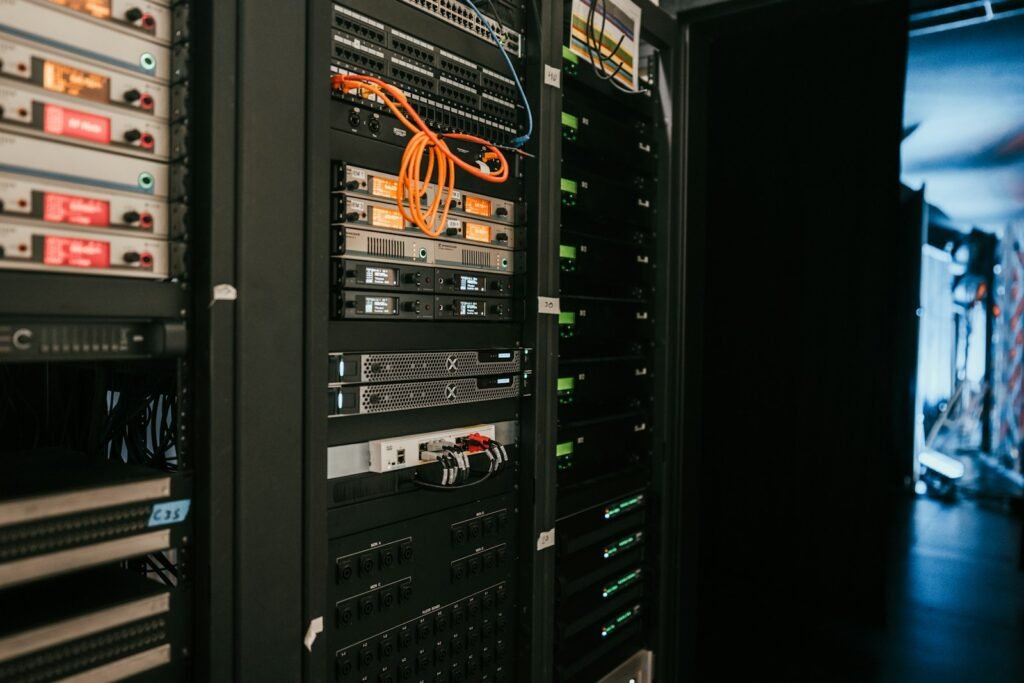
Featured-image credit: illustrative server-room photograph by Kevin Ache via Unsplash; it does not depict an identified Alphabet data center.