
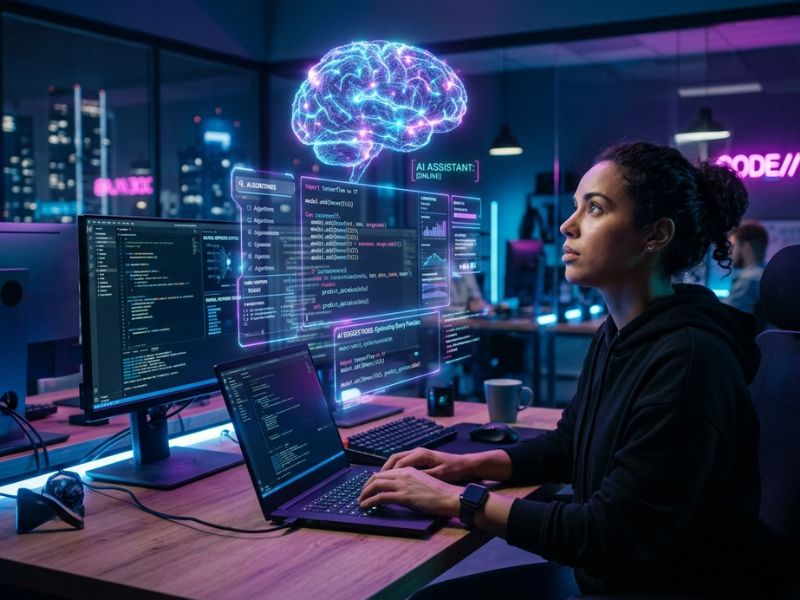
Vibe coding is a new phenomenon that helps you write code using AI for software. These days, many developers use AI tools to create code and not write code from scratch. This process goes by vibe coding. In easy terms, it is stating what you wish to make & AI will create the first draft of the code. The programmer then gradually tests and enhances the code, reviewing it as they do.
Many developers, startups & learners are using vibe coding nowadays as it saves time and makes coding easier to begin. Furthermore, it assists teams in the rapid creation of prototypes and minor applications. In this guide, you will find the vibe coding meaning, its origin, and the actual meaning behind this new AI-powered coding.
What Is Vibe Coding?
What is vibe coding? Vibe coding refers to creating software by maintaining a certain vibe in the presence of AI. Rather than writing every line of code, you configure what you want built & an AI tool writes the code. The developer reviews the output, tests it, makes improvements, and gets it working correctly.
This method employs large language models that comprehend human speech as well as programming languages. Programmers can provide simple prompts such as “ build a login page with email validation,” and the AI will give the skeleton code.
The concept of vibe coding is straightforward. While thinking about logic and the idea the developer works on, with the help of AI, the technical code is produced much faster. The movement from idea to working software occurs in a shorter amount of time.
Because of this, there is now an uptake of vibe coding by startups, indie developers, and learners wanting to build applications quickly.
If you want to understand the complete concept from beginner to advanced level, read our detailed vibe coding guide. It explains the workflow, tools, and practical steps used by developers.
Vibe Coding definition
Vibe coding means building software by describing what you want and letting AI generate the code.
In place of starting with a blank file, the developer writes a prompt explaining the feature or application they want to create. The request is analyzed by AI and generates code that tries to complete the task. The developer evaluates the output by executing the program, and finally makes the program final.
Let’s say you’re a developer who wants to create a simple to-do list web app. They can ask for an AI tool instead of writing the whole script from scratch.
Develop a basic to-do list web application using JavaScript featuring adding, deleting, and marking complete options.
In just seconds, the basic structure of the code for the application is generated by the AI. The developers can then run the code to see if it works, along with.
Vibe coding accelerates development, as seen in this example. It offers a starting point that works and assists developers in refining it rather than starting from scratch.
Where the term came from and how people use it now
Where the term came from
As AI tools became better at writing good code, developer discussions started including the term vibe coding. As large language models improved, a new way of programming was increasingly experimented with. Rather than writing lines of code manually, they described the construction of what they wanted to build, and AI did it for them. The new workflow felt different from coding, so the developers began to refer to it as vibe coding.
AI researcher Andrej Karpathy spoke about this type of development, popularizing the concept and idea. He explained how simple prompts can be helpful to developers for guiding AI models into code. Rather than planning everything out first, developers could experiment and test the outputs to see what comes from it.
The term vibe coding spread rapidly in development circles, blogs, and social media as a result. A description of how AI assists in coding through rapid experimentation and prompt coding.
How people use it now
Currently, software is being built using Vibe coding to freely use various AI tools while developing. AI takes care of code generation. Developers only explain their objectives to AI and review the result.
This is what developers usually do when they want to build a prototype, small app, automation script, or an internal tool. Consequently, they can swiftly transform concepts into a functional feature. Many startups resort to vibe coding to put innovative product ideas through the testing phase without investing much time.
It is also a very popular programming language among beginners. Through AI-generated examples, they can learn about the functions of the different parts of a program.
Nowadays, vibe coding refers to a collaborative workflow between developers and AI, where humans guide the process & ML helps evolve the code faster.
What vibe coding is (and isn’t)
Vibe coding is a new method of software development that utilizes artificial intelligence technology. With this technique, developers state what they want to make & AI tools generate the code’s first version. The developer tests the output given by the code, improves it, and finally implements it. Human creativity and AI speed boost the ability of software developers to create software.
The true meaning of collaborative coding refers to the collaboration of humans and AI. Decision-making on how the software ought to work continues to remain with developers. Application architects design apps, examining the resulting code and rectifying auto-generated code problems as they arise. AI just functions as a clever assistant, creating code from the prompt.
Vibe coding is often misunderstood. Some think it is letting AI build a complete application that requires no human work. Some believe it to be a standard code-predictor or visual app builder. In fact, vibe coding is positioned between hand coding and automation.
Developers still need programming knowledge in Vibe coding. Developers should read the AI-generated code and ensure conformity with good development practices. The engineers need to inspect the application, verify its performance, and verify if the system is safe.
This process works better for prototyping, trying out different ideas, and quickly developing small applications. It enables developers to progress from idea to user-ready program more quickly than coding does.
Nonetheless, the role of the developer persists with vibe coding. By shifting focus from coding to ideation, designing & problem solving, the workflow is significantly altered. This replacement is being executed by AI.
To properly comprehend vibe coding, we need to see how it differs from other approaches to AI development.
How Major Tech Platforms Define Vibe Coding
Several technology companies and developer platforms have also explained the concept of vibe coding in their own way. For example, Google Cloud describes AI-assisted development as a workflow where developers guide intelligent tools to generate and refine code while still maintaining responsibility for testing, architecture, and deployment decisions.
Security companies like Cloudflare also explain that modern AI coding tools can help developers create features faster by generating code suggestions, automation scripts, and application logic. Meanwhile, IBM highlights that AI-assisted programming works best when developers treat generated code as a starting point rather than a final solution. Platforms built for rapid development such as Replit similarly emphasize that AI coding tools allow developers to move from idea to working software much faster while still reviewing and improving the generated code.
Not the same as “Copilot autocomplete only”
A lot of developers are already using AI tools that can suggest the next line of code as they type. These features are often referred to as autocomplete assistants. These tools assist developers in writing software code much faster than they otherwise could.
That said, this is not vibe coding, no. Autocomplete tools primarily aid in minor tasks like completing a code line or recommending a brief function. Most of the program is still written manually.
Vibe coding comes with more than mere hints. The AI is capable of creating entire functions, components, or features instead of generating only a few lines. According to the developer’s goal, an AI writes a large part of the code itself.
After the developer reviews the output, run the program and it will improve the result. As a result, the workflow between the developer and the AI system was improved as it became interactive.
Not the same as no-code (differences in control/governance)
Another common misconception is that vibe coding is the same as no-code development. Even though both approaches aim to simplify application building, they work in very different ways.
In no-code platforms, users create applications through visual tools with drag-and-drop interfaces. These tools are designed for people who have little or no programming experience. Users simply connect components and set rules to build apps without writing code. In contrast, modern AI development methods such as agentic coding go beyond simple visual building. AI agents can assist in generating and improving code, but the development process still involves programming knowledge.
When you use vibe coding or agentic coding approaches, you are still programming. The code generated by AI must be reviewed, understood, and improved by a developer. This process helps maintain proper code ownership, allowing developers to stay in control of the application’s structure, logic, and performance.
Governance and control also differ between the two approaches. Most no-code platforms offer built-in features that users can use to design cloud applications. Thus, not every system component will be customizable due to this limitation. On the other hand, AI-assisted development offers flexibility while ensuring clear ownership of the developed code and controlling how the finished product will be used.
With vibe coding, developers are able to alter the design, modify the logic and build their own security. A visual builder or bedding framework will not restrict them.
Due to this flexibility, coding via vibe is more effective for developers who want both speed and control. Artificial Intelligence generates loose code, but the software finalization and ensuring technical quality lie with the developer only.
Why it’s popular (speed, accessibility, prototyping)
Many people believe vibe coding is similar to no-code development, but that’s not the case. While both approaches have the same goal of simplifying application building, they are very different.
No-code platforms allow the user to create applications through visual tools. Tools like these have been designed for non-programmers or one who has little. Users simply connect components and set rules to build apps without writing code. In contrast, AI-assisted development works more like having an intelligent pair programmer. The AI is able to suggest code, fix bugs, and create features but ultimately developers guide the process and make decisions.
Using vibe coding is still programming. Developers often go through iterative refinement, where they review the AI-generated code, adjust prompts, and improve the output step by step. Some tools even offer a quick “accept all” option for suggested changes, but experienced developers usually review the code carefully before applying it.
This process also protects code ownership, because the developer remains responsible for understanding and managing the structure, logic, and performance of the application.
Governance and control also differ between the two approaches. In most no-code platforms, users rely on built-in features provided by the platform. Because of this limitation, they may not be able to customize every part of the system. In AI-assisted development, developers keep more flexibility while still maintaining full code ownership and control over the final product.
Trade-offs you must acknowledge (quality, maintainability, security)
Vibe coding can speed up development, but it takes a hit on quality. Before relying on AI code generation, it is better if the developers understand these limits. Being aware of the dangers allows teams to use vibe coding smartly and safely.
One major issue is code quality. AI code generators can produce valuable code, but can also produce inaccurate results. At times, the coding can have flaws like bugs, bad design, or inefficient logic. If developers copy the code without thorough checks, the end application may not work properly. Due to this, developers need to read and test the generated code carefully.
Another difficulty is maintainability. Software projects tend to grow. As new features are added, the old code needs upgrading. The inability of developers to comprehend AI-generated code can make it difficult to uphold. Fixing issues or improving the system will be tough for future developers. Organized and clean code eliminates complexity; hence, the importance of reviewing the code after a specific duration.
Concern exists for security as well. AI-generated code may rely on weak authentication or outdated library support. When these problems aren’t fixed, they could present security risks. Developers have to check their code for vulnerabilities and follow safe coding practices.
When a programmer sees the AI’s output as a starting point that works best for coding. Developers can reap the benefits of AI and avoid searing consequences by reviewing the code, testing it thoroughly, and adopting robust security practices.
Quick “start here” links
Next, take a look at how the vibe coding workflow works in real life.
Examine the prompt loop where developers explain a task, produce code, execute it, and improve the outcome. The process illustrates the collaboration between AI and developers.
It will be an impressive thing to see. There are many tools to generate code for building apps or tests. Choosing the right tool would help in making the learning process easier.
Study techniques on prompts, too. Clever prompts allow AI to produce solid code. Usually, better results emerge from clear instructions.
Understand how vibe coding can cause security issues. If you learn safe coding practices today, you’ll build reliable software when using AI tools.
FAQs
1. What is vibe coding in simple words?
Vibe coding means using AI tools to generate code by writing simple prompts. The developer explains the idea, and the AI creates the code.
2. Who introduced the term vibe coding?
The term became popular after AI researcher Andrej Karpathy discussed this new AI-assisted style of programming.
3. Do you need coding knowledge for vibe coding?
Yes. Basic programming knowledge is still important. Developers must review the AI-generated code and fix errors if needed.
4. Is vibe coding good for beginners?
Yes, it can help beginners learn faster. They can see real code examples and understand how programs work.
5. What are common uses of vibe coding?
Developers often use vibe coding for prototypes, small apps, automation scripts, and learning projects.