
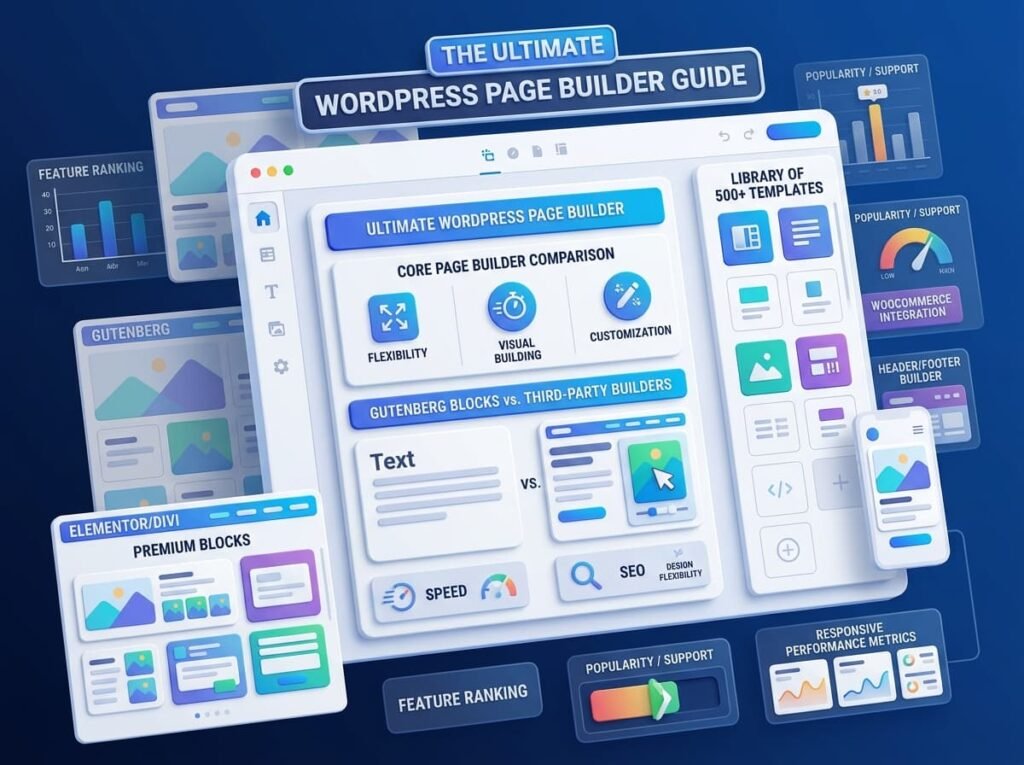
The best WordPress page builders will definitely make creating a WordPress website a breeze; however, selecting one won’t be simply choosing the most popular page builder. There might be two builders that offer a drag-and-drop feature, yet these two might be completely different in terms of speed, price, flexibility, and maintainability.
Our pick for 2026 is Elementor since it will provide an easier experience overall. Bricks is better for developers who are concerned with performance, whereas Divi would work better for freelance developers and agencies with multiple websites.
The comparison was made based on usability, performance, responsiveness, flexibility of design, templates, WooCommerce functionality, pricing, ecosystems, and maintainability.
Best WordPress Page Builders at a Glance
| Builder | Best for | Free version | Ease of use | Performance | Pricing model |
|---|---|---|---|---|---|
| Elementor | Best overall/beginners | Yes | Excellent | Good | Annual |
| Bricks | Developers and speed | No | Moderate | Excellent | Annual/lifetime |
| Divi | Agencies and lifetime value | No | Good | Good | Annual/lifetime |
| Breakdance | WooCommerce/all-in-one | Yes | Good | Very good | Annual |
| Beaver Builder | Stability and client sites | Limited | Very good | Very good | Annual |
| Spectra | Gutenberg users | Yes | Good | Excellent | Free/annual |
| SeedProd | Landing pages | Yes | Excellent | Very good | Annual |
Winner: Elementor is the best all-rounder, Bricks is the more performance-oriented choice, and Divi is the best choice for the multi-site value proposition.
How We Evaluated These WordPress Page Builders
We went past flashy templates and a number of features. The most critical thing about builders is their behavior once the site is launched.
Our criteria include editor usability, learning curve, responsive design tools, theme creation capabilities, dynamic content, WooCommerce integration, templates, widgets, cost, licensing, updates, and size of ecosystem around it.
Performance is another important aspect, because while having a visually stunning site is cool, it won’t do you any good if it adds additional weight to your page or makes it harder to keep Core Web Vitals up to date. Yet, the performance scores listed below are comparative evaluations and not the results of any controlled test on identical pages hosted on identical hosting.
We took into account lock-in effect too. Think of how hard it will be to maintain or recreate your website if you change tools at some point.
The 7 Best WordPress Page Builders
1. Elementor: Best Overall WordPress Page Builder
It is still easy to get started with Elementor for most of the WordPress users. You can build pages with no need to code due to the visual editor, and you will be supplied with templates, widgets, add-ons, and other design tools within the ecosystem.
The basic plan will suit smaller sites best, and the premium plans provide you with more options like the Theme Builder, dynamic blocks, forms, pop-ups, and WooCommerce integration. At present, Elementor charges depend on how many sites you have.
Best feature: Easy to use and flexible in design.
Disadvantage: The high amount of widgets, add-ons, animations, and badly optimized resources increases the complexity of the pages.
Who will benefit most from it: Beginners, marketers, small businesses, freelancers, and business websites in general.
Conclusion: Elementor is the best choice for WordPress page builders for most people.
2. Bricks: Best for Performance and Developers
The Bricks approach is different. Instead of being just another page builder plugin tacked onto WordPress, it is a visual theme-building tool with more advanced controls over layout, classes, dynamic data, and site structures.
This is going to be a delight for developers, with its CSS-driven workflow, global classes, query loops, and dynamic content features. It was also developed with performance and clean output in mind.
The downside here is the learning curve. An individual with no experience of using WordPress may find Bricks harder to use than Elementor.
Bricks currently provides yearly plans as well as a lifetime license that allows for unlimited sites and all future updates for one price.
Best feature: Developer flexibility and performance-oriented approach.
Drawback: It is technology-based, unsuitable for beginners.
Perfect for: Developers, agencies, and performance-oriented users.
Summary: Bricks is one of the best page builder plugins for WordPress that gives you all the control and performance without many third-party plugins.
3. Divi: Best Lifetime Value
One of the most favored WordPress themes ever is Divi; what sets it apart from the rest of its competitors is its visual editor and wide range of layouts they offer.
Divi stands out amongst other themes owing to its licensing system, which is a great way of doing things if you plan on creating more than one website using this particular theme. Divi offers inbuilt A/B testing as well, something that might come in handy for marketers.
The newer Divi 5 version is mostly concerned with improving the base experience and performance.
Best feature: Extensive design ecosystem and multi-site value proposition.
Weakness: Potential customers need to think about the long-term consequences of working within the Divi ecosystem.
Recommended For: Freelancers and agencies with several websites.
Conclusion: Divi is one of the most powerful WordPress page builder themes for those who value a mature ecosystem and longevity of the product.
4. Breakdance: Best Modern All-in-One Builder
Breakdance is a new-generation builder that has a wide range of features. The page builder allows visual design features, dynamic data, conditions, popups, forms, and even WooCommerce integration without needing a large number of plugins to work.
WooCommerce features in the Breakdance builder are very powerful. The Breakdance builder has a wide range of elements for products, product loops, shop, cart, checkout page, filters, and conditional layouts.
Positive aspect: WooCommerce compatibility and advanced site-building capabilities.
Negative aspect: The availability of third-party plugins is inferior to that of the Elementor editor.
Who is it for? WooCommerce merchants and contemporary agencies.
Conclusion: Breakdance is one of the best page builders for WordPress.
5. Beaver Builder: Best for Stability
Beaver Builder has a more subdued style, and this is precisely what makes the platform popular.
It is all about delivering a stable editing process that would be clear to both agencies and their customers.
Theme building support, WooCommerce, multisite support, and agency-friendly features are offered by Beaver Builder. The plans start from a single site and go up to unlimited sites.
Perhaps you won’t get the visual effects experience offered by other platforms; however, this could be quite helpful for long-term client projects.
Best thing: stability and maintainability.
Downside: fewer cool design options and templates compared to competitors.
Best For: agencies, freelancers, organizations managing clients’ websites.
Conclusion: Beaver Builder is among the best page builders on WordPress in case you prioritize stability and ease of client management over visual effects.
6. Spectra: Best Gutenberg-Based Page Builder
If you enjoy using the block editor of WordPress but would like more design tools, Spectra is something that should be looked into.
Rather than replacing Gutenberg with a new system entirely, Spectra builds on the native block editing system of WordPress. For that reason, it’s perfect for bloggers, publishers, and other website owners who require additional design tools without having to give up the native interface of WordPress.
Another positive aspect of Spectra is its free version.
Top feature: Integration with Gutenberg.
Disadvantage: Doesn’t offer as much visual freedom as some other standalone editors.
Target audience: Bloggers and Publishers.
Conclusion: Spectra is one of the finest page builders available for WordPress.
7. SeedProd: Best for Landing Pages
The SeedProd page builder is especially good when you want conversions and not to create a large content-driven website.
It has a drag-and-drop page builder that features landing page blocks, responsive options, templates, coming soon pages, maintenance pages, subscriber pages, and marketing modules. Theme building and WooCommerce are available in premium plans.
As a result of its landing page-oriented workflow, it can quickly create campaign pages, lead generation pages, opt-in pages, and temporary website pages.
Best part about this page builder: Quick landing page creation for conversions.
Weakness: Not the right platform for very dynamic websites.
Who is it meant for: Campaign managers and marketers.
Conclusion: SeedProd is one of the best WordPress page builders for marketers looking for great-looking landing pages without wasting a lot of time.
Elementor vs Bricks: Which Is Better?
Elementor vs Bricks is an issue of simplicity and complexity.
| Factor | Elementor | Bricks |
|---|---|---|
| Ease of use | Winner | More technical |
| Performance | Good | Winner |
| Code/CSS control | Moderate | Winner |
| Templates and add-ons | Winner | Smaller ecosystem |
| Dynamic sites | Strong | Excellent |
| Best user | Beginners/marketers | Developers/agencies |
For a beginner user, the choice between Elementor and Bricks is not difficult at all. Elementor has a friendlier visual workflow and a bigger ecosystem.
For a developer, however, the choice can be different. With Bricks, you have more control over CSS, classes, dynamic content, and even your website structure. You can construct more structured websites using fewer tools than with Elementor.
If you consider the Elementor vs Bricks choice, try thinking about how the website is going to be maintained. If the client needs to update his or her own website, then Elementor’s UI can be very convenient. If your developers are more technical and performance matters, then Bricks may be a better foundation for your websites.
In summary, the choice between Elementor vs Bricks is not one that has to do with what features each builder has.
Divi vs Elementor: Which Should You Choose?
Divi vs Elementor is yet another comparison in which your business model counts.
| Factor | Divi | Elementor |
|---|---|---|
| Free version | No | Yes |
| Lifetime license | Available | Not available |
| Template ecosystem | Excellent | Excellent |
| Ease of use | Moderate | Winner |
| A/B testing | Built in | Requires another solution |
| Add-on ecosystem | Large | Winner |
| Multi-site value | Winner | Can become expensive |
When comparing Divi vs Elementor, the winner for Elementor is when it comes to beginning users. This tool allows free use to start the process without paying any money, while its paid services include additional website building solutions.
Divi will look more appealing to those who are working on several websites belonging to their clients and require licensing based on wide usage.
So, a Divi vs Elementor comparison for freelancers and agencies should consider overall ownership cost instead of just the first-year costs.
The main difference between Divi vs Elementor is the workflow itself. It makes Elementor easier to use, while Divi could become a good long-term solution for users who know how to use this platform.
For most users, Elementor will be a better choice, especially for the beginning stage.
Which WordPress Page Builder Is Best for You?
The best WordPress page builders will not be the same for all websites. Your skills and the nature of your project will determine the most suitable builder.
- Beginner – Elementor
- Developer – Bricks
- Freelancer with several websites – Divi
- WooCommerce Store – Breakdance
- Client Maintenance Over Time – Beaver Builder
- Gutenberg User – Spectra
- Landing Pages – SeedProd
As a first-time entrepreneur who is creating a website, you must not use the builder with the longest features list. Use the builder that makes your work simpler.
Do You Actually Need a Page Builder?
But not all WordPress websites require a separate builder.
If you have a simple blog, documentation website, portfolio, or a content-centric website, then Gutenberg may fulfill all your requirements. Using a native block-based process can also reduce your dependency on a separate builder and can make your site more manageable in the long run.
A dedicated builder is something that you need only when you require complex layouts, a design system, responsive control, templates, popups, custom header & footer, and even WooCommerce designs.
WordPress page builders shine when the WordPress editor starts restraining your designs.
Frequently Asked Questions
Which is the most popular WordPress page builder?
Elementor is among the top picks when it comes to WordPress page builders owing to its easy-to-use interface, affordable prices, robust environment, and numerous design features. The solution suits novices and businesses alike.
Which is the best free WordPress page builder?
Elementor is our best choice in terms of free options for general users. Spectra is another awesome alternative if you like Gutenberg. The choice will depend on your needs for an additional visual editor or enhanced block editor experience.
Which is the fastest WordPress page builder?
There are no winners, as many things affect page loading speed, such as hosting service, theme choice, images, additional plugins, fonts, caching services, etc. Both Bricks and Spectra can be good choices if used correctly.
Is Bricks better than Elementor?
It can be for developers who pay more attention to code structure, custom CSS usage, dynamic data, and good performance. Elementor is better for beginners, marketers, and people who need a bigger ecosystem and easy visual editing.
Is Divi better than Elementor?
There is no winner, as different factors may matter. For example, Elementor is usually easier for beginners and has a free option. Divi can be better for freelancers and agencies who make multiple sites and need other licensing benefits.
Do page builders slow down WordPress?
Yes, although not the builder itself. The page will load slowly when there are too many widgets, animations, third-party plugins, images, bad hosting services, poorly written scripts, etc. However, a well-built page will work just fine.
Final Verdict
Comparing all the above mentioned options, we consider Elementor to be the one which gives the best results for most users of WordPress. It provides the best balance in terms of design, user-friendliness, and integration. In turn, Bricks is the one that is more suitable for developers, and Divi is the best choice from the point of view of costs for multi-site users.
The right decision is not the one that boasts the longest list of features. Select the option which suits your approach, skill level, budget, and maintenance plan.
For professional development of WordPress sites, you can contact us regarding BitCodeSolution’s WordPress development services.