
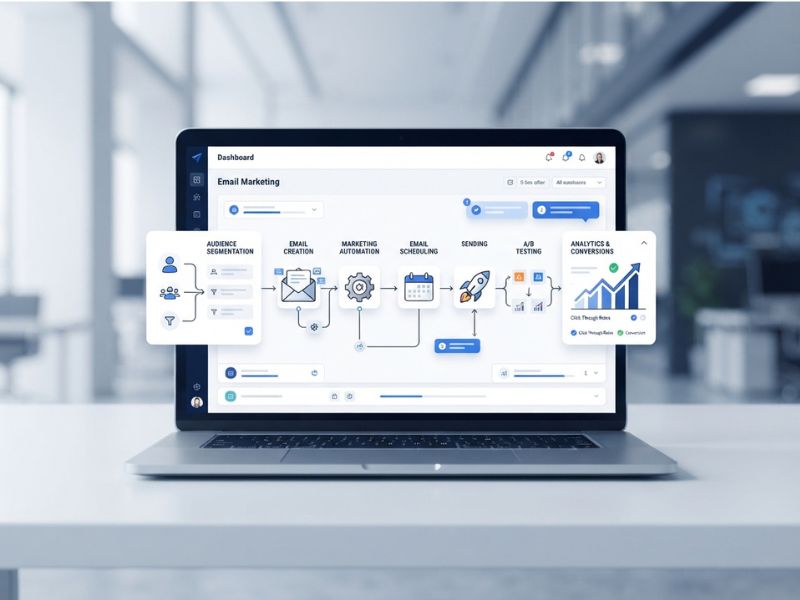
One of the most profitable ways to boost your business growth is creating successful email marketing campaigns. With email, you can establish contact with customers, gain their trust and make more sales. Email marketing is cheap and provides good returns on investment.
Good email marketing campaigns are not only about promoting products. Rather, these campaigns help to resolve issues, provide valuable information and motivate your audience to act. Regardless whether you run a small or large business, mastering the art of creating email marketing campaigns will be beneficial for you.
Here you will find all the tips and tricks needed to create email marketing campaigns successfully. Also, you will learn the proven email marketing techniques that businesses from the USA use.
What Is an Email Marketing Campaign?
Email marketing campaign is a set of emails which is delivered to certain groups with a single objective. Such objectives can be to market a product, welcome new members, increase site visitors or attract inactive customers.
Efficient email marketing campaigns are designed prior to being distributed. Every email has an objective. Every letter motivates the reader to take the next step.
Companies use email marketing techniques to make their campaigns more personalized by delivering various messages depending on the client’s interests and actions.
In case the email marketing campaign is conducted properly it will result in better customer relations and revenues for the company.
Campaign vs. Single Email vs. Automation Sequence
These concepts often confuse beginners.
Single Email
The concept of a single email means one email sent only once. It can be about sales, company news, or promotion of the latest blog post.
Email Marketing Campaign
In contrast, an email marketing campaign consists of several emails working towards the same objective. Each new email adds to the previous one.
For instance, holiday promotional campaigns consist of such types of emails as:
- Announcement email
- Reminder email
- Last chance email
These emails become part of a range of successful email marketing campaigns.
Automation Sequence
Automation sequence consists of automatic sending of emails after particular actions of the customer.
It can include:
- Welcome emails
- Abandoned cart emails
- Birthday emails
- Order confirmation emails
Email marketing automation is the most intelligent strategy.
Step 1: Define Your Campaign Goal
Any effective email marketing campaign begins with a clear objective.
Without an objective, your message will be unclear to the readers.
Asking yourself questions like these would help:
- Do you want more sales?
- More subscribers?
- Website traffic?
- Repeat buyers?
Pick one objective first before starting to write.
Companies that keep just one objective for their email marketing campaigns tend to achieve success.
Awareness, Conversion, Retention Goals
Awareness Campaigns
Awareness campaigns bring your brand into the picture.
Such emails can contain:
- Articles
- News about your company
- Guides
- Industry news
The awareness email marketing services help create trust in advance of any sales.
Conversion Campaigns
Conversion campaigns motivate subscribers to do something.
They can consist of:
- Make a purchase right now
- Request a demo
- Download an ebook
- Attend a webinar
These email marketing strategies help companies get more leads.
Retention Campaigns
Retention campaigns maintain the interest of existing customers.
You can send:
- Loyalty rewards
- Updates on products
- Discount offers
- Tips
Customer retention is more cost-efficient than lead generation. That is why retention remains one of the most efficient ways of email marketing.
Step 2: Segment Your Audience
Every customer does not want the same thing. Sending the same emails to everyone will demotivate people.
So it becomes necessary to divide your audience into smaller parts. It is known as segmentation.
Email marketing campaigns become more successful for companies due to audience segmentation, as each customer receives relevant information. It motivates people to open emails.
Behavioral Segmentation
In behavioral segmentation, subscribers are segmented according to their actions.
Some examples are:
- Product views
- Purchasing behavior
- Clicks from emails
- Website traffic
- Shopping cart interaction
For instance, a person may view running shoes without buying them.
This enables you to use an email marketing campaign with those running shoes, including testimonials about the product and discount offers.
It is considered one of the best email marketing techniques since it is very timely.
Demographic Segmentation
Demographic segmentation segments people by using personal information.
Such personal information can include the following:
- Age
- Gender
- Place
- Designation
- Income
- Industry
For instance, an application company would segment business owners and marketers and market separately to them.
A retail store can use different email marketing techniques depending upon whether its customers live in cold or warm places.
Such personalized emails will be more relevant and effective as they generate higher response rates and better conversions.
Step 3: Write Compelling Copy & Subject Lines
For your email marketing program to be effective, great copywriting is necessary. Your email should contain valuable information and at the same time be clear. It is worth noting that your email marketing recipients receive thousands of emails every day; therefore, your email must capture their attention. Your email must consist of the subject line and the body copy.
There are quite a number of companies that have adopted an email marketing approach where the language is clear and there is a value proposition to meet consumers’ needs.
Remember that when doing an email marketing campaign, you need to write for your audience and not yourself.
Subject Line Best Practices
The subject line you select will determine whether recipients read your email.
The ideal subject line must:
- Be short and concise
- Be helpful and descriptive
- Be interesting but credible
- Be relevant to the contents of the email
Some examples of effective subject lines include:
- “20% Discount On Your Next Purchase”
- “Free Guide Is Ready For You”
- “5 Techniques To Enhance Your Marketing”
Do not include too much capitalization or spam words such as “FREE!!!”, as they could negatively affect delivery.
One of the most effective email marketing tactics includes experimenting with subject lines. Minor adjustments can result in huge gains in terms of openings.
Personalized emails are an essential part of successful email marketing campaigns. Inclusion of recipient’s name or interests can help personalize emails.
CTA Placement and Clarity
CTA stands for Call to Action; it is what you ask your reader to do.
CTAs are such as:
- Shop Now
- Learn More
- Book a Call
- Download Guide
- Start Free Trial
The CTA has to be distinct enough. Only use one CTA at once; otherwise, you can distract your audience.
The most successful email marketing campaigns only have one CTA, which corresponds to the overall goal of the campaign.
For instance:
- Sales email → “Buy Now”
- Educational email → “Read More”
- Webinar email → “Register Now”
Effective CTAs will increase clicks, thus making your email marketing campaign successful.
Step 4: Design the Email
The design of emails affects the way people read and respond to your email. A good design will help people understand your email better. Your design also builds trust and helps you build a brand identity.
Professional email marketing utilizes well-designed templates, minimal use of graphics and clearly defined sections. Good design should complement your message.
Mobile-First Design
Emails are read on mobile devices most of the time.
Hence, your emails need to be designed keeping in mind mobile users.
Here are some tips that you can follow:
- Short paragraphs
- Readability of fonts
- Large buttons
- Lightweight images
- Simple layout
A mobile-friendly design is an essential component of today’s email marketing campaigns. Poor mobile display will cause many users to delete your emails immediately.
An effective email marketing campaign would offer the same experience for desktop, laptop, and mobile users alike.
Brand Consistency
Emails should conform to brand identity.
This means that they will include:
- Company logo
- Color scheme
- Font types
- Writing style
Incorporating brand identity into emails ensures faster recognition by the customers.
This is to mean that an email sent by a clothing company should be fashionable while an email marketing software company should adopt a professional writing style.
Branding an email marketing campaign adds to its credibility. It builds better relations with the subscribers.
Step 5: Set Up Automation & Timing
Automation allows companies to send the appropriate message at the appropriate time.
Instead of having to manually send each and every message, automation technology can send messages depending on the action performed by customers.
This increases the efficiency of your email marketing campaign.
Some examples of automated emails include:
- Welcome emails
- Product recommendations
- Abandoned cart notifications
- Customer follow-ups
Automation is one of the most potent email marketing tactics as it enhances engagement without any additional daily effort.
Best Send Times
Timing to send will depend on your audience. Weekdays tend to do great for most US businesses.
Some common timing to test are:
- Tuesday morning
- Wednesday afternoon
- Thursday morning
- But audiences differ.
The best strategy would be to test timing and see what works. A good email marketing campaign uses data and not just intuition.
See how your open rate and click-through rate perform.
Drip Sequence Structuring
A drip sequence is an automatic email sequence sent over time.
A basic drip sequence could be:
- Email 1: Welcome email
- Email 2: Informative email
- Email 3: Offer of product/service
- Email 4: Reminder email
Drip sequences assist in guiding customers in their purchasing process.
The use of drip sequences is beneficial in the following cases:
- New subscribers
- Leads
- Online shoppers
- Existing customers
Drip sequences make email marketing campaigns more effective as they enable regular communication.
Combining automation, timing, and informative content makes successful email marketing campaigns for businesses.
Step 6: Test Before Sending
Always test your emails before sending them to avoid even minor mistakes that may have an impact on your outcome and reputation.
Through testing you will identify mistakes before your subscribers find them and improve the overall performance of your email marketing campaigns.
You need to test:
- Email design
- Links
- Images
- Subject lines
- Spelling
- Mobile display
The right test will make your email marketing campaign appear more professional and reputable.
A/B Testing Subject Lines
A/B testing refers to testing of two versions of an email against each other in order to identify the version that works better.
It can be used to test:
- Subject lines
- Call-to-action buttons
- Layouts of the emails
- Pictures/images
- Length of content
One can send a subject line to half of their recipients and another subject line to the other half, for instance. The winner will be the one with better outcomes.
A/B testing is among the most effective email marketing techniques since it enables one to base their decisions on data.
Many email marketing campaigns are successful because of continued testing and learning.
Spam and Deliverability Checks
The term email deliverability refers to the ability of your emails to get into the right inbox.
At times, the emails end up in spam due to bad practices.
Some ways of enhancing deliverability include:
- Using a reliable email marketing platform
- Steering clear of spam words
- Having a clean email list
- Providing an unsubscribe feature
- Sending valuable information
A good email list is very important for increasing the impact of your email marketing campaign.
Email deliverability is very important in email marketing strategies since no matter how great your emails are, they will be useless if they never get delivered.
Step 7: Analyze Campaign Performance
Email sending does not mark the end of the process. It is important to analyze results and see what has helped you. Analytics can be helpful in developing further email marketing strategies campaigns. Critical information includes information about how your subscribers have engaged with your emails.
Key Metrics to Track
Open Rate
The open rate KPI will tell you the number of opens of your emails.
If there is an increased open rate, then it just means that the subject line has been engaging and relevant enough.
Your open rates will be increased by trying out different possibilities for the subject lines.
Click-Through Rate (CTR)
This will determine the number of clicks received from the links contained in the emails.
A high click-through rate means that your email copy and CTA have been good.
CTR optimization is one of the key goals of many email marketing campaigns.
Conversion
Conversion refers to measuring whether people have taken an action that you desire.
Examples include:
- Purchase
- Form fill up
- Booking some service
- File download
Conversion metrics will help you determine whether your email marketing campaigns have been successful or not.
Unsubscribes
The Unsubscribes metric is used for determining how many people unsubscribed from your email list.
A high unsubscribe rate could be because of the following reasons:
- Too many emails
- Content is irrelevant
- Poor audience segmentation
Email Marketing Strategies That Convert
It’s simple to create emails. However, crafting emails that yield success needs a proper strategy.
There are different ways businesses adopt emails to attract customers and achieve success. Below are some effective ways that make a difference.
Seasonal and Promotional Campaign Strategy
The seasonal campaigns capitalize on the use of holidays and special occasions in their efforts to capture people’s attention.
Some examples include:
- Black Friday Deals
- Discounts during holidays
- Summer deals
- New Year deals
The above email marketing strategies create urgency among the customers and make them act fast.
An effective promotional email should have:
- An offer
- Deadline
- Effective call to action
- Eye-catching images
Do not send numerous promotional emails.
Re-Engagement Campaign Strategy
Some of these customers may stop opening emails over time.
In order to get these people back into the game, a re-engagement campaign should be conducted.
This includes sending out:
- “Miss you” emails
- Discounts
- Product news
- Surveys
Email marketing re-engagement is one of the most successful email marketing strategies.
The right email marketing campaign will remind customers of what made them sign up for your list.
Product Launch Campaign Strategy
An example of a product launch campaign is one that creates buzz for an upcoming new product or service.
Example of a basic product launch email campaign:
- Email 1: Introduction of new product
- Email 2: Product features/advantages
- Email 3: Product customer testimonials
- Email 4: Reminder of product launch
This creates buzz, resulting in increased sales.
Most organizations use product launch email marketing strategies to create demand for their product before its launch date.
Conclusion
Learning the basics of email marketing campaigns allows businesses to reach out to customers and develop much faster.
The successful implementation of such a campaign requires a goal to be set, the right target audience, quality content, and an appealing design. Analyzing the results of your efforts will help you to optimize every future email marketing campaign.
With proper use of email marketing strategies, any business can engage customers, earn their trust and make sales.
Email marketing is a powerful tool that can be implemented into the strategy of any type of business.
FAQs
How long should an email marketing campaign run?
It all depends on the objective and audience for how long your email marketing campaign will run; the campaign could be run for just a few days or weeks. The promotional campaign is often a short one while the educational campaign can be a longer one.
In order to have your email marketing campaign successful, you should check its performance while the campaign is running. Checking open rate, click-through rate, and conversions, among others, can help you adjust your message where needed.
What’s a good conversion rate for an email campaign?
A successful conversion rate will vary according to your niche and target market as well as your particular marketing goal. For many organizations, success is measured by constant improvement rather than hitting a particular mark. A successful email marketing strategy is one that aims at getting the right message to the right people.
Through personalization and a good CTA, your conversions may be increased. Your current performance should always be compared to your previous campaigns.