
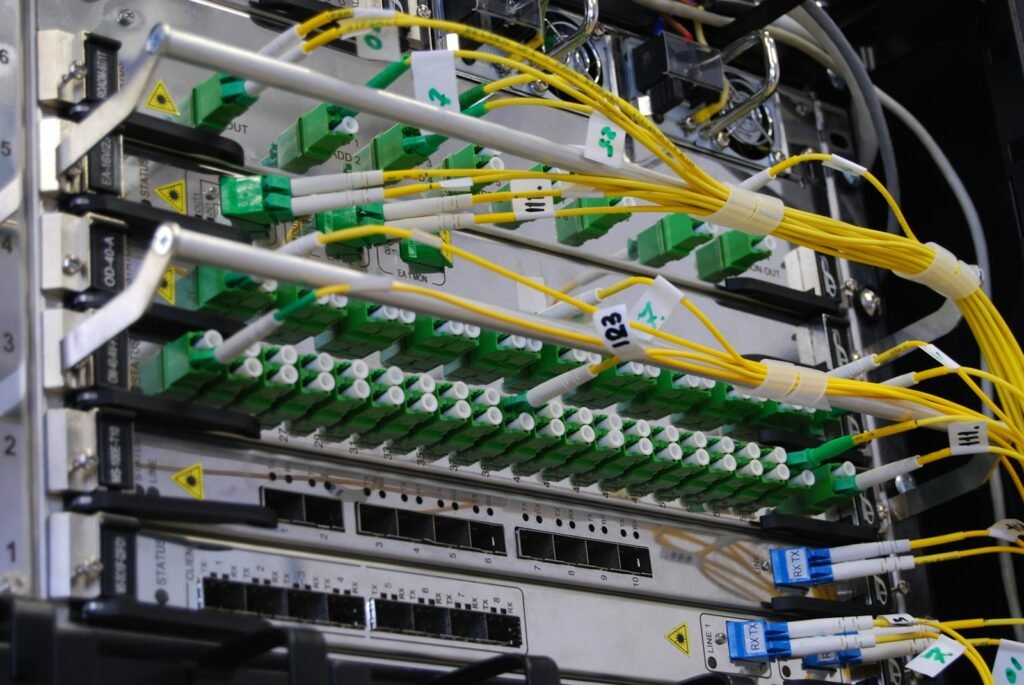
November 3, 2026 — Marvell Technology has agreed to acquire optical-components specialist Lumentum in a stock-for-stock transaction carrying an implied enterprise value of approximately $115 billion. Announced in the United States on November 2, the proposed combination is a high-profile wager that the next constraint on artificial intelligence infrastructure will be moving information efficiently between processors, not simply manufacturing more computing chips.
The Marvell Lumentum acquisition would bring together Marvell’s custom silicon, network switching and interconnect technologies with Lumentum’s lasers, optical transceivers and photonics manufacturing capabilities. The companies say the merger could help customers build faster, more power-efficient connections inside increasingly large AI data centers. The agreement is definitive, but the merger is not complete: both companies’ shareholders and regulators must still approve it.
Marvell Lumentum acquisition: What the companies agreed
According to the companies’ November 2 announcement filed with the US Securities and Exchange Commission, Lumentum shareholders would receive 4.5 Marvell common shares for each Lumentum common share. That fixed exchange ratio implied about $1,132 per Lumentum share when the agreement was announced. The companies calculated a roughly 23.9% premium using their unaffected October 28 closing prices, before speculation about negotiations emerged.
The frequently quoted $115 billion figure is an enterprise value, not a cash purchase price. Enterprise value includes debt-related adjustments and should not be confused with the value of the shares issued. Reuters reported an equity value of approximately $102.54 billion. Because the consideration consists of a fixed number of Marvell shares, its market value may change as Marvell’s stock price moves before completion.
After closing, existing Marvell shareholders are expected to hold around 67% of the combined company on a fully diluted basis, while Lumentum shareholders would own approximately 33%. Both boards approved the transaction unanimously. Marvell Chairman and Chief Executive Matt Murphy is expected to remain chairman and CEO, with three Lumentum directors, including CEO Michael Hurlston, joining Marvell’s board.
The announced target for closing is the first half of calendar 2028, subject to required votes, regulatory review and customary conditions. Until those steps are completed, Marvell and Lumentum remain separate businesses, and customers should not assume integrated products or pricing are immediately available.
Why optical connections matter to AI infrastructure

Table of Contents
AI computing clusters are often described in terms of the accelerators that train or run models. Yet those processors must exchange enormous volumes of data with neighboring chips, memory systems and equipment in other racks. A fast processor can sit idle if the network cannot deliver information where it is needed. As clusters grow, the amount of data moving between components becomes a major design and operating challenge.
Electrical interconnects built around copper remain important, particularly across short distances, but longer and higher-bandwidth links can place difficult demands on signal integrity and power. Optical technologies transmit information using light, making them attractive for selected high-speed connections. Converting between electrical and optical signals is itself a technical and economic challenge, however; a shift toward optics does not mean copper will disappear from data centers overnight.
Marvell contributes semiconductor design, digital signal processing, switching and custom AI-related chip expertise. Lumentum contributes laser technology, transceivers, optical circuit switching and specialized compound-semiconductor production. The strategic premise is that designing these components together could reduce integration friction and support new approaches to connecting processors within and across systems.
The companies also highlight the importance of optical links across multiple network architectures, including connections within a package or system and links spanning entire facilities. Those are distinct engineering problems with different distances, cost limits and reliability requirements. Whether a combined supplier can address them more effectively will depend on product execution, customer qualification and real-world deployment results.
A large market estimate, but not guaranteed revenue
In the SEC-filed announcement, the companies say the combination could expand their total addressable market to $550 billion. They also point to a potential more than $1 billion in annual run-rate cost synergies and anticipate an improvement in Marvell’s non-GAAP earnings per share during the first year after closing.
These figures are management expectations, not audited outcomes from the future combined business. An addressable market is an estimate of spending that might be served by relevant products; it is neither a sales forecast nor a commitment from customers. Similarly, projected savings depend on integration and execution, and an earnings-per-share projection does not establish how the transaction will affect all accounting measures or cash flow.
The scale of the proposed transaction also raises questions about valuation. Reuters reported that both companies’ shares were under pressure as investors weighed the cost of the acquisition against uncertainty about the durability of AI spending. A strong market for AI networking today does not eliminate the possibility of changing customer budgets, component shortages, rival products or a slower pace of data-center construction.
What it means for cloud providers and chip competition
The transaction could strengthen Marvell’s position in a market where technology companies increasingly customize silicon and networking to fit their own AI workloads. Rather than buying only general-purpose chips, major cloud operators are considering the full computing system: accelerators, memory, switches, optical modules, software and electricity usage all affect performance and cost.
Reuters identifies Broadcom as a significant rival in the custom-chip and AI connectivity market. Combining Marvell’s designs with Lumentum’s optical portfolio could broaden what Marvell can offer customers, but that does not guarantee market-share gains. Customers will still compare pricing, production capacity, supply-chain resilience and integration with existing platforms.
The agreement follows a year of intense attention on cloud computing infrastructure. BitCodeSolution has previously covered Google Cloud’s revenue growth and AI infrastructure spending, highlighting the capital required to scale these services. Our report on Alibaba Cloud’s Amsterdam data-center expansion offers another example of the industry’s capacity-building efforts. Neither article establishes demand for Marvell or Lumentum products specifically; they provide context for the wider investment cycle.
Regulatory approval and integration risks remain
A deal of this size will face scrutiny from shareholders and competition authorities. Regulators may review how the combined business would affect competition for high-speed optical components, semiconductor designs and related technology. Approval requirements can also create timing uncertainty. The companies have set a target date, not promised that closing will happen on schedule.
Integration presents a separate test. Bringing together research teams, manufacturing operations, software, product road maps and customer relationships can be complex, especially in businesses selling specialized components that require lengthy validation. A successful merger would need to preserve ongoing deliveries while developing new integrated offerings and meeting the financial expectations used to justify the acquisition.
For enterprise buyers and cloud architects, the practical questions include whether optical products are interoperable with existing systems, how replacement parts and support will be handled, and whether suppliers can provide predictable lead times. The deal may eventually affect sourcing strategies, but customers should rely on current contracts and confirmed product road maps rather than assuming immediate changes.
What to watch next
The next milestones are formal merger disclosures, shareholder votes, regulatory decisions and any updates to the expected 2028 close. Investors will also look for evidence that demand for lasers, optical transceivers and related networking technologies is translating into sustainable sales and profits. Public announcements about potential synergies are only an opening benchmark for that assessment.
For now, the verified development is a signed all-stock agreement announced on November 2, 2026, with an implied $115 billion enterprise value for Lumentum. The larger story is the changing balance of AI investment: as computing clusters expand, the connections between chips and facilities are becoming central to both engineering decisions and multibillion-dollar corporate strategy.
Frequently asked questions
How much is Marvell paying to acquire Lumentum?
The announced all-stock transaction implies a $115 billion enterprise value for Lumentum. The fixed consideration is 4.5 Marvell shares for every Lumentum common share; Reuters put the implied equity value at about $102.54 billion.
When will the Marvell and Lumentum deal close?
The companies expect closing in the first half of calendar 2028, subject to shareholder approvals, regulatory clearances and other conditions. The transaction has not yet closed.
Why is Lumentum important for AI data centers?
Lumentum makes lasers and other optical components that move data at high speeds. Those connections can help support large AI computing clusters as networking bandwidth and power efficiency become increasingly important.
Reporting basis: Marvell-Lumentum’s November 2, 2026 SEC-filed joint statement and Reuters’ November 2 reporting. Forward-looking estimates are attributed to the companies.